 Web Hosting
 Windows HostingBuilt for Windows apps and websites – stability, speed and flexibility
 Reseller HostingLaunch a hosting business without technical skills or expensive infrastructure
 Affiliate ProgramRefer customers and earn commissions from sales across our platform
 Domain SearchFind and secure a domain name in seconds with our quick lookup tool
 CO ZA Domains
 All DomainsExplore domain names from over 324 TLDs globally – all in one place
 Free Whois Lookup Tool South Africa
 VPS
VPS Website Builder
 Online ShopSet up a sleek eCommerce store with zero coding knowledge
 SSLs
SSLs SupportAccess help articles, how-tos, and everything about our services
 Blog
Blog Contact UsReach our team instantly via live chat or drop us an email
If you’re choosing between Truehost and xneelo for a website in South Africa, both offer established hosting options.
But they aren’t necessarily aimed at exactly the same customer.
This comparison looks at pricing, hosting types, storage, bandwidth, control panel, WordPress support, email, SSL, backups, performance, support, scalability, and ease of use.
That way you can see where each one genuinely holds up.
Worth saying upfront: the cheaper option isn’t automatically the better one.
Sometimes it is.
Sometimes the more expensive plan earns its price through included features or support quality.
This guide breaks down where that trade-off actually plays out.
Table of Contents
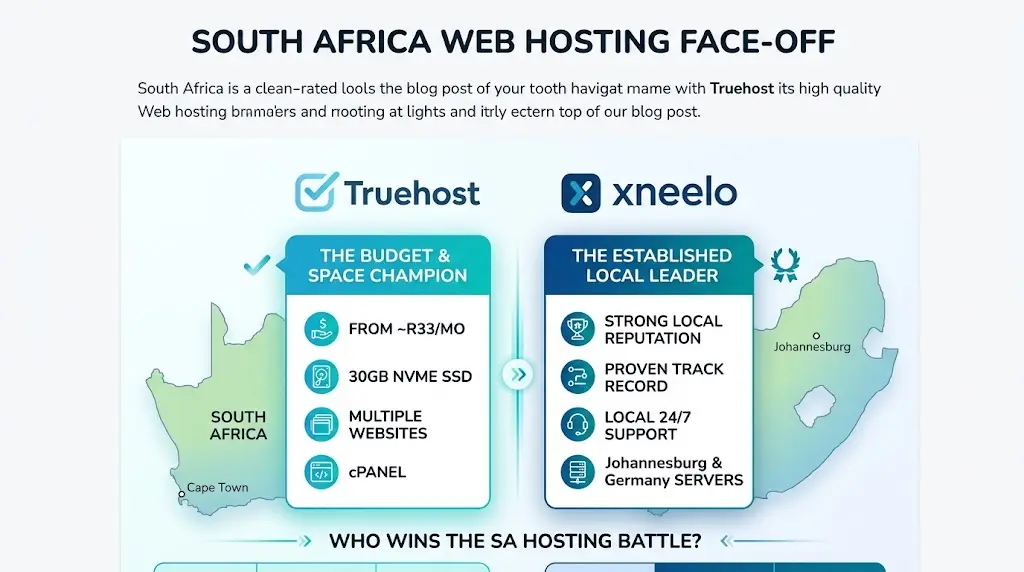
xneelo vs Truehost Comparison at a Glance
| Feature | Truehost | xneelo |
|---|---|---|
| Starting price | From around R33-35/month (triennial billing) | From R99/month |
| Hosting type | Shared, VPS, Cloud | Shared, Volume Plan (reseller), Managed/Self-Managed Servers, Cloud |
| Storage | 30 GB NVMe SSD (entry plan) | 5 GB SSD (entry plan) |
| Bandwidth | Unlimited | Unlimited (subject to acceptable-use policy) |
| Number of websites | Multiple (varies by plan) | 1 (entry plan), scales with higher tiers |
| SSL | Free, included | Free, included |
| Unlimited email accounts | Included, limits vary by plan | |
| Backups | Free daily backups | Free daily backups |
| Control panel | cPanel | konsoleH / xneelo’s own Control Panel |
| WordPress | Softaculous one-click install | Built-in app installer, one-click WordPress |
| Website migration | Free migration included | Migration support available |
| Customer support | 24/7 live chat, tickets, phone | 24/7 support, strong local reputation |
| Server location | Johannesburg, South Africa | Johannesburg, South Africa (also Germany option) |
| Best for | Budget-conscious users wanting generous storage and cPanel | Users prioritising a long local track record and don’t mind paying more |
Use the current plan-specific figures on each provider’s site to confirm before publishing. Promotional pricing shifts fairly often on both sides.
1) Pricing
Truehost’s entry-level shared hosting is genuinely aggressive on price.
It starts around R33 to R35 a month on a three-year billing term, working out to roughly R400 for the first year.
Higher shared tiers step up from there, generally landing in the R80 to R150 a month range depending on storage and website count.
Annual plans typically bundle in a free .co.za domain too.
Renewal pricing stays reasonably close to the promotional rate rather than jumping dramatically.
xneelo’s shared hosting starts considerably higher, from R99 a month for its Basic plan.
That’s before even reaching the Starter, Advanced, or Master tiers, which climb further as storage and features increase.
Billing can run monthly, quarterly, biannually, or annually depending on payment method.
xneelo’s pricing is displayed in Rand with VAT included, which is convenient for local budgeting even if the headline number is higher than Truehost’s.
What’s included differs too.
Truehost bundles free daily backups and free migration into its shared plans from the entry tier up.
xneelo includes daily backups and free SSL as standard across its shared lineup as well.
So the core inclusions are fairly comparable, the real gap here is mostly the base price itself.
2) Storage
Truehost’s entry plan offers a genuinely generous 30 GB of SSD storage.
That’s a lot for a budget-tier plan, and it gives real breathing room for a growing WordPress site or small store.
xneelo’s entry Basic plan offers just 5 GB of SSD storage.
The Starter, Advanced, and Master tiers step up to 10 GB, 15 GB, and 20 GB respectively on the standard shared lineup, though some listings show entry tiers reaching up to 15 GB or the largest shared plan reaching 100 GB depending on which product line you’re looking at.
Both providers use SSD storage rather than older spinning drives, so raw read/write speed is comparable.
The real difference is how much space you get for your money at the entry level.
3) Bandwidth and Traffic
Both providers advertise unlimited bandwidth on their shared hosting plans.
In both cases that comes with an underlying acceptable-use policy rather than a truly limitless guarantee.
It’s worth being clear that unlimited or unmetered bandwidth doesn’t mean unlimited server resources.
CPU and RAM are separate, finite resources on both platforms regardless of how bandwidth is worded. xneelo specifically lets users configure PHP memory limits themselves through their control panel, up to a capped maximum per domain on shared hosting.
That’s a useful bit of transparency not every host offers.
4) Number of Websites
Truehost’s entry-level plan typically allows hosting multiple websites on one account, commonly up to 10.
That’s a real advantage for anyone managing more than one site from the start.
xneelo’s entry Basic plan is generally limited to a single hosted domain, with higher tiers unlocking more.
This distinction counts for quite a bit.
Freelancers managing client sites, agencies juggling multiple projects, businesses running separate sites for different purposes, and individuals hosting both a personal and a business site all benefit from not paying for two separate accounts.
5) SSL and Website Security
Both providers include free SSL certificates as standard across their shared hosting plans, with automatic renewal so you’re not stuck manually reissuing certificates.
Truehost includes SSL from the entry tier with no separate installation step required.
xneelo similarly bundles free SSL into every shared plan.
Beyond SSL itself, both providers offer standard account-level security measures appropriate for shared hosting.
Deeper malware scanning or advanced security add-ons are worth checking individually on each provider’s current plan pages, since these details shift over time and shouldn’t be assumed to be identical.
6) Email Hosting
Truehost includes unlimited email accounts on its shared plans.
That means you can set up something like [email protected] without hitting an account cap.
xneelo also includes email hosting with mailbox and alias allowances that scale by plan tier, along with webmail access.
Included business email genuinely affects the real value of a hosting plan.
A professional email address is something most small businesses need anyway, and getting it bundled in rather than paid for separately is a meaningful part of the overall value comparison here.
7) Backups
Both Truehost and xneelo include daily backups as standard on their shared hosting plans.
That’s good news, since backups are one of those features that quietly count for more than most people realise until something goes wrong.
Retention periods and exactly how straightforward restoration is can vary.
It’s worth confirming the specifics directly with either provider rather than assuming identical policies.
This is another spot where the cheapest headline price isn’t necessarily the cheapest overall option if one provider’s backup or restoration process ends up requiring a paid add-on.
8) Control Panel and Ease of Use
This is one of the more noticeable differences between the two.
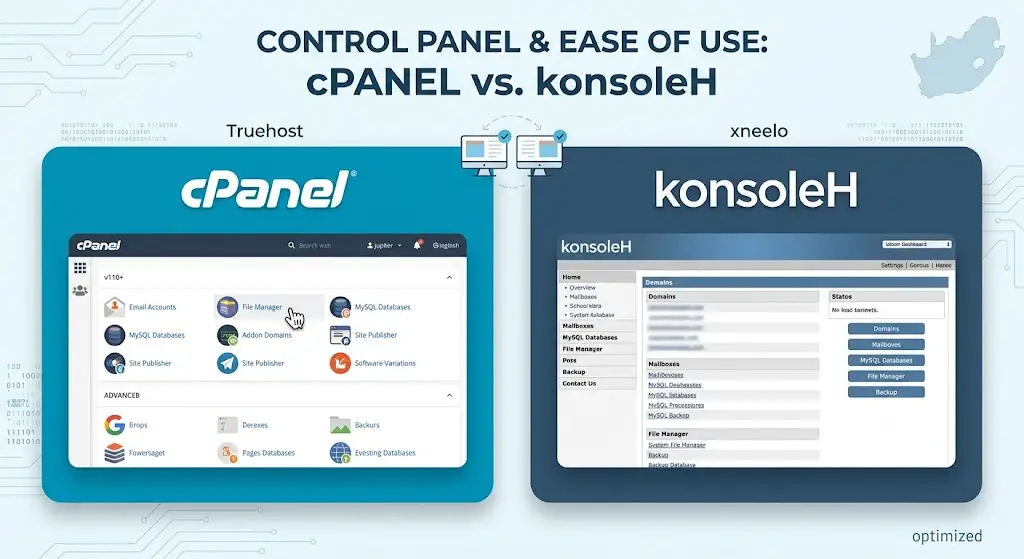
Truehost uses cPanel, the most widely recognised hosting control panel.
That means broad documentation, a familiar layout if you’ve used any other cPanel host before, and one-click tools for file management, databases, email, and DNS all in one place.
xneelo uses its own custom-built control panel, konsoleH, alongside a newer proprietary Control Panel it’s been rolling out.
Reviews of konsoleH are mixed.
Some long-time users find it perfectly functional, while others describe it as dated compared to cPanel.
It handles the same core tasks, website and file management, databases, email, DNS, and one-click app installs.
But the learning curve may be slightly steeper for beginners who’ve never used anything other than cPanel before.
9) WordPress Hosting
Both providers support one-click WordPress installation, Truehost through Softaculous, xneelo through its own built-in app installer.
Both include free SSL and backups alongside WordPress hosting on their standard shared plans.
For a personal blog, either provider’s entry plan is more than sufficient.
For a business website, Truehost’s larger default storage allocation and multi-site support give it a slight edge for anyone running more than one property.
For a portfolio site, both work comfortably well.
For a WooCommerce store specifically, storage and resource headroom count for more as the catalog grows.
Truehost’s more generous entry-tier storage may mean less pressure to upgrade early compared to xneelo’s smaller Basic tier.
10) Website Performance
Performance depends on several combined factors rather than any single one: server hardware, storage technology, server location relative to your visitors, network quality, caching setup, the underlying web server software, and how resources are allocated per account.
Both providers run infrastructure out of Johannesburg, which benefits South African visitors with lower latency compared to hosting overseas.
xneelo also offers a German server option for some products, useful if you have a more international audience.
Truehost’s shared hosting runs on newer NVMe storage and modern web server technology across its lineup.
xneelo’s entry-level shared hosting has traditionally run on a more conventional Apache-based setup, with Nginx and LiteSpeed available on select higher tiers rather than across the board.
Neither provider is going to outperform the other dramatically for a small to medium site under normal traffic.
The differences show up more at scale or under specific technical configurations.
11) Website Migration
Truehost includes free website migration with its hosting plans, handling the transfer of files, databases, and other hosting data once you provide access to your current host.
xneelo also offers migration assistance, though the specifics of what’s covered for free versus what requires additional support can vary by situation.
It’s worth knowing the difference between moving your hosting and transferring your domain. These are separate processes. Moving hosting means shifting where your website files and email live.
Transferring a domain means moving the domain’s actual registration to a new registrar.
You can move your hosting without touching your domain registration at all, simply by updating DNS to point at the new host.
12) Customer Support
Both providers offer 24/7 support.
Truehost provides live chat, ticket support, and phone support around the clock, along with a self-service knowledge base.
xneelo has built a strong local reputation over its long history in the South African market, with support channels covering similar ground.
Experiences reported by users do vary though, some describe fast, detailed responses, others report slower turnarounds during busier periods.
As with most hosting comparisons, checking recent reviews close to your signup date tends to be more useful than relying purely on either company’s own marketing claims.
13) Scalability
Both providers offer a path upward as a website grows.
Truehost’s shared plans scale up in storage and website count, with VPS and cloud hosting available once shared hosting no longer fits.
xneelo similarly offers upgrade paths from its Basic shared tier through Master, alongside Volume Plans for hosting many sites under one account, and self-managed or managed dedicated servers and cloud infrastructure for larger, more demanding projects.
The practical takeaway is that neither provider is likely to leave you stranded if your site grows significantly.
Both offer a reasonable upgrade path so you’re not forced into switching hosts entirely just because your first plan got too small.
Which Web Host Makes More Sense for Your Website?
There isn’t one universal winner here.
For someone prioritising affordable, feature-rich shared hosting with generous storage, cPanel, and a straightforward setup process, Truehost tends to make more sense, particularly for beginners or anyone managing multiple sites on a budget.
For someone whose needs align more closely with xneelo’s ecosystem, its long-established local reputation, or its specific product range like Volume Plans and cloud infrastructure, xneelo remains a genuinely viable option.
If Truehost’s combination of lower entry pricing, generous storage, and included backups and migration sounds like the better fit for your website, explore Truehost’s shared hosting plans and get started with a setup built for South African website owners.
Frequently Asked Questions
Is xneelo the same as Hetzner South Africa?
Yes, xneelo was previously known as Hetzner South Africa. It rebranded but remains a separate legal entity from Hetzner Online GmbH in Germany, despite the shared naming history.
Is Truehost cheaper than xneelo?
Generally, yes, at the entry level. Truehost’s shared hosting starts considerably lower than xneelo’s Basic plan. Still, it’s worth comparing the specific features and storage included at each price point rather than just the headline number.
Can I move my website from xneelo to Truehost?
Yes, website migration between the two is possible. Truehost offers migration assistance to help transfer your files, databases, and hosting data over to a new account.
Can I keep my domain registered with xneelo and host it with Truehost?
Yes, your domain registration and your hosting are separate services. You can keep your domain registered wherever it currently sits and simply update the DNS settings to point toward your new hosting provider.
Which is better for WordPress, Truehost or xneelo?
Both support one-click WordPress installation with free SSL and backups included. Truehost’s larger entry-tier storage gives it a slight edge for WordPress sites expected to grow. xneelo remains a solid, reliable option for smaller WordPress installs.
Which is better for a small business website?
Both work well for a small business site. Truehost’s lower entry price and multi-site support suit budget-conscious businesses running more than one site. xneelo’s long local track record may appeal to businesses prioritising an established provider over the lowest possible price.
Does Truehost offer hosting in South Africa?
Yes, Truehost offers hosting with South African infrastructure and Rand-based pricing tailored to the local market.
Which provider is better for multiple websites?
Truehost’s entry-level shared plan generally supports more websites on one account out of the box compared to xneelo’s single-domain Basic tier. That makes it the more straightforward option if you’re managing several sites from day one.