 Web Hosting
 Windows HostingBuilt for Windows apps and websites – stability, speed and flexibility
 Reseller HostingLaunch a hosting business without technical skills or expensive infrastructure
 Affiliate ProgramRefer customers and earn commissions from sales across our platform
 Domain SearchFind and secure a domain name in seconds with our quick lookup tool
 CO ZA Domains
 All DomainsExplore domain names from over 324 TLDs globally – all in one place
 Free Whois Lookup Tool South Africa
 VPS
VPS Website Builder
 Online ShopSet up a sleek eCommerce store with zero coding knowledge
 SSLs
SSLs SupportAccess help articles, how-tos, and everything about our services
 Blog
Blog Contact UsReach our team instantly via live chat or drop us an email
Unlimited vs unmetered bandwidth is one of those comparisons that trips people up because the two terms sound almost interchangeable.
Hosting companies advertise both constantly, often on the same page, sometimes even in the same sentence.
But they don’t necessarily mean the same thing.
Here’s the short version before we go deeper.
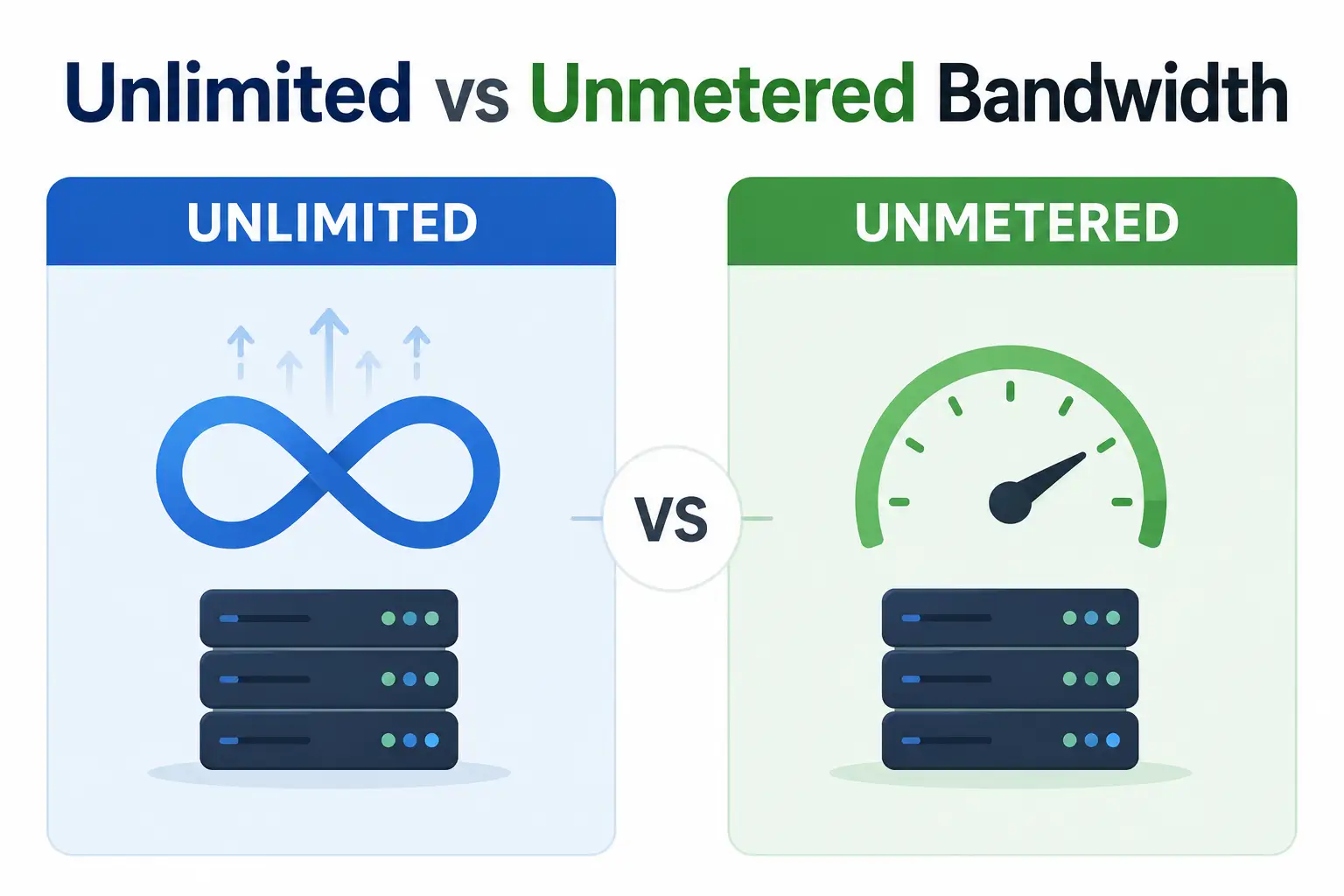
Unlimited bandwidth generally means there’s no stated monthly transfer cap under normal use.
Unmetered bandwidth means your data transfer isn’t measured against a fixed allowance at all.
Neither one means the server has infinite capacity.
That’s the part marketing pages tend to gloss over, and it’s exactly why knowing the real difference is worth your time before you choose a plan based on a word in a pricing table rather than what’s actually behind it.
This article breaks down how providers actually enforce these limits in practice, what the two terms really mean once you look past the label, and which option makes more sense depending on the kind of website you’re running.
Table of Contents
Unlimited vs Unmetered Bandwidth Comparison
Here’s the comparison in one table, so you can see the shape of the answer before we unpack it.
| Feature | Unlimited Bandwidth | Unmetered Bandwidth |
|---|---|---|
| Fixed monthly bandwidth quota | No stated quota | No metered quota |
| Bandwidth measured against allowance | Generally no | No |
| Physical network capacity | Finite | Finite |
| Connection speed | Plan-dependent | Plan-dependent |
| CPU limits | Still apply | Still apply |
| RAM limits | Still apply | Still apply |
| Storage limits | Still apply | Still apply |
| Fair-use policy | May apply | May apply |
| Overage charges | Usually not based on GB | Usually not based on GB |
| Traffic spikes | Generally accommodated within plan limits | Generally accommodated within connection capacity |
| High-volume traffic | Depends on overall resources | Depends on connection/resource capacity |
| Unlimited network speed | No | No |
| Unlimited server resources | No | No |
| Best interpretation | No stated transfer cap under normal use | No usage-based bandwidth quota |
And now we unpack the table.
1) Bandwidth Measurement and Monthly Limits
The core difference starts here.
A metered plan comes with a fixed monthly transfer allowance, say 5 TB or 10 TB, and once you cross it, you pay overage fees or get throttled.
Unlimited bandwidth generally drops that fixed quota altogether, at least on paper, for normal usage.
Unmetered bandwidth takes a slightly different angle.
Rather than promising no limit exists, it means your usage simply isn’t counted against an allowance in the first place.
In both cases, you won’t see a “you’ve used 80% of your monthly transfer” warning the way you would on a metered plan.
But that absence of a visible counter doesn’t mean nothing is being tracked behind the scenes.
2) Network Capacity and Connection Speed
This is one of the most important distinctions to grasp, because it’s where the two terms genuinely diverge.
Unmetered doesn’t mean unlimited speed.
A hosting plan can offer unmetered bandwidth while still running on a connection with a fixed, finite capacity, commonly described as port speed, something like 1 Gbps or 10 Gbps.
That port speed is the real ceiling.
You can transfer as much data as you want without being billed per gigabyte, but you can’t push more data through that connection than its physical capacity allows.
The same logic applies in reverse to unlimited bandwidth.
Just because a plan says unlimited doesn’t mean it hands you infinite network throughput either.
It simply means the provider isn’t setting a hard monthly transfer cap under typical conditions.
The underlying connection still has a real, physical limit.
3) Traffic Spikes and High-Volume Usage
This is where the theory meets reality.
Picture a blog post going viral, a product launch driving a sudden rush of visitors, seasonal ecommerce traffic during a big sale, breaking news coverage, or a marketing campaign that performs better than expected.
Both unlimited and unmetered plans are generally built to absorb these spikes better than a rigid metered allowance would.
But here’s the catch that trips a lot of website owners up.
Even with generous bandwidth terms, CPU, RAM, and overall network capacity can become the real bottleneck long before bandwidth itself does.
A sudden flood of visitors doesn’t just move more data, it also demands more processing power to generate pages, run database queries, and handle simultaneous connections.
That’s a separate constraint entirely from how your bandwidth is labeled.
4) CPU, RAM and Server Resources
This is genuinely one of the most important pieces of this whole comparison.
Bandwidth describes data transfer.
It says nothing about how much computing power your website actually gets to run.
CPU determines how fast your server can process requests. RAM determines how many processes it can juggle simultaneously without slowing to a crawl.
The number of processes and PHP workers available limits how many pages your site can generate at once, particularly relevant for WordPress and other dynamic sites.
Input/output capacity affects how quickly your server can read and write data, and the number of concurrent connections allowed determines how many visitors can be served in the same moment.
All of these are separate resources from bandwidth, and all of them are still finite regardless of whether your plan says unlimited or unmetered.
This is exactly why an unlimited bandwidth shared hosting plan can still slow down or struggle under heavy traffic.
Bandwidth was never the constraint in that scenario, computing resources were.
5) Storage and File Limits
Neither unlimited nor unmetered bandwidth has anything to do with how much disk space you get.
Storage is a separate resource entirely, and it comes with its own limits regardless of your bandwidth terms.
That includes overall disk space, inode limits (the total number of files your account can hold, which trips up sites with lots of small files), database size, and how well your plan handles large media files.
It’s worth repeating plainly, since it’s easy to conflate the two: neither unlimited nor unmetered bandwidth means unlimited storage.
6) Fair-Use and Acceptable-Use Policies
This is where marketing language meets the actual terms of service, and it deserves its own honest look.
Most unlimited and unmetered plans operate under some form of fair-use or acceptable-use policy.
These policies exist to prevent one account from consuming a disproportionate share of shared server resources, running large-scale file distribution, or streaming heavy media in a way that affects other customers on the same infrastructure.
If a provider notices usage patterns that look more like resource abuse than typical website traffic, they may step in, ask you to upgrade, or apply restrictions.
It’s worth framing this accurately rather than cynically.
This isn’t really a case of unlimited plans secretly aren’t unlimited.
It’s more accurate to say that unlimited generally applies to bandwidth usage within the provider’s normal hosting environment, not unrestricted use of every server resource without limit.
That’s a meaningful distinction, and knowing it upfront saves you from being surprised later.
7) Large Files, Downloads and Streaming
Bandwidth terms play out differently depending on what you’re actually delivering.
Large software downloads, video files, audio libraries, live streaming, and extensive media libraries all place very different demands on a server than a typical text-and-image website does.
Even when bandwidth is advertised as unlimited or unmetered, shared hosting often isn’t the right environment for this kind of heavy media delivery.
Fair-use restrictions tend to kick in faster here, and shared infrastructure simply isn’t built for sustained, high-volume media transfer the way a dedicated server or specialized streaming platform is.
8) Website Performance
It’s worth being direct about this: neither unlimited nor unmetered bandwidth automatically makes a website faster.
Performance actually comes down to a combination of factors, network capacity, CPU and RAM, the type of storage technology behind your account (SSD versus older spinning disks, for instance), caching, database performance, overall server configuration, whether a CDN is in the mix, and even the physical location of the server relative to your visitors.
Bandwidth labeling sits somewhat separately from all of this.
A site with unlimited bandwidth on a poorly configured, overloaded server will still feel slow.
9) Cost and Billing

This is genuinely one of the more useful practical angles to compare.
With a fixed hosting price and no overage billing, both unlimited and unmetered models generally offer predictable monthly costs, since neither one bills you based on how many gigabytes you transferred.
Traffic-related charges are typically absent from both models too, which is precisely their appeal over metered plans.
The interesting nuance here is that both models can offer that same predictability.
What actually determines your real-world costs is the provider’s specific terms, promotional pricing that jumps sharply at renewal, and how transparently those renewal rates are disclosed upfront, not which of the two labels is printed on the plan.
10) Scalability and Upgrades
Eventually, most growing websites outgrow their original hosting plan.
The typical progression runs from shared hosting, to a higher-tier shared or business plan, then to VPS, cloud hosting, or a dedicated server as needs increase.
It’s worth knowing that bandwidth usually isn’t the reason for that upgrade.
A site can have plenty of bandwidth available under either an unlimited or unmetered label and still run into a wall because of CPU or RAM limits well before bandwidth becomes the bottleneck.
11) Website Types
Different kinds of websites benefit from these bandwidth models to different degrees.
Blogs, small business websites, and standard WordPress sites tend to do just fine on either unlimited or unmetered shared hosting, since their traffic and resource demands are relatively modest.
Ecommerce sites, photography portfolios, and news websites push things further, particularly around image-heavy pages and traffic spikes during sales or breaking stories, so resource allocation counts for more than the bandwidth label itself.
High-traffic websites and media-heavy sites, especially anything involving video or large file delivery, tend to outgrow shared hosting’s practical limits regardless of how bandwidth is marketed.
And are usually better served by VPS, cloud, or dedicated infrastructure built for that kind of load.
What Should You Look at Instead of the Bandwidth Label?
Here’s where this shifts from which marketing term sounds better to how do I actually evaluate a hosting plan.
Rather than fixating on whether a plan says unlimited or unmetered, it’s far more useful to compare the resources that actually determine how your site performs.
That means looking at
- CPU allocation,
- RAM,
- real network speed rather than just the bandwidth label,
- storage space,
- inode limits,
- the number of PHP workers available,
- how many concurrent connections the plan supports,
- the physical server location relative to your audience,
- whether CDN support is included,
- the provider’s backup policy,
- the specifics of their fair-use policy,
- uptime track record,
- how easy it is to upgrade later,
- and critically, renewal pricing rather than just the introductory rate.
These are the details that determine whether your site actually runs well, and none of them show up in a single word on a pricing page.
So, Should You Choose Unlimited or Unmetered Bandwidth?
Neither is automatically better.
Unlimited generally means there isn’t a stated bandwidth quota under normal use, while unmetered means your data transfer isn’t counted against a fixed allowance, though the connection still has finite physical capacity either way.
For most website owners, the more important question isn’t whether a plan says unlimited or unmetered.
It’s whether the hosting package actually provides enough CPU, RAM, storage, network capacity, and other resources for the website you’re running.
Get those fundamentals right, and the specific bandwidth label becomes far less consequential than it initially seems.
If you’re weighing this decision for a South African audience specifically, Truehost South Africa offers shared hosting plans built around genuinely usable resource allocations rather than just a headline bandwidth term.
Worth a look if you want a plan where the fundamentals, not just the label, are actually solid.
Frequently Asked Questions
Can I change from an unlimited bandwidth plan to an unmetered plan?
Usually, yes, though it depends on your specific provider and often involves moving to a different plan tier or hosting type rather than a simple toggle. It’s worth checking with your host directly about what switching involves and whether it requires a migration.
Can I use unlimited bandwidth hosting for multiple websites?
Many shared hosting plans with unlimited bandwidth do support multiple websites on one account, though the exact number allowed depends on the specific plan. Keep in mind that hosting multiple sites still shares the same underlying CPU, RAM, and storage limits, regardless of how bandwidth is labeled.
Does unlimited bandwidth affect my website’s SEO?
Not directly. Bandwidth labeling itself isn’t a ranking factor. What counts for SEO is whether your site loads quickly and stays available, which depends more on server performance, CPU, RAM, and configuration than on whether your plan says unlimited or unmetered.
Does bandwidth affect website hosting costs?
It can, though less directly than you’d expect with unlimited or unmetered plans specifically, since neither charges based on data transferred. Costs are driven more by overall plan tier, included resources, and provider pricing structure than by the bandwidth model alone.
How can I monitor my website’s bandwidth usage?
Most hosting control panels, including cPanel, include a bandwidth or resource usage section showing your account’s data transfer over time. Analytics tools and server logs can also help track usage patterns if you want more detail.
How do I know how much bandwidth my website is using?
Check your hosting control panel’s usage statistics, which typically break down data transfer by day or month. If your site handles a lot of media or has grown significantly, it’s worth checking this periodically rather than assuming usage stays flat.
Can a CDN reduce my website’s bandwidth usage?
Yes, a CDN can meaningfully reduce the load on your origin server by caching and delivering content from servers closer to your visitors, which cuts down on repeated data transfer from your main hosting account.
Can I host videos on unlimited bandwidth hosting?
You can host some video content, but shared hosting, even with unlimited or unmetered bandwidth, generally isn’t well suited to large-scale video hosting due to fair-use restrictions and resource limits. Embedding video from a dedicated platform is usually a better approach for anything beyond occasional short clips.
What happens if my website suddenly goes viral?
With unlimited or unmetered bandwidth, a traffic spike is less likely to trigger overage charges compared to a metered plan. However, your site could still slow down or struggle if CPU, RAM, or concurrent connection limits are exceeded, since bandwidth was rarely the actual constraint in these situations.
Can unlimited bandwidth hosting handle international visitors?
Generally, yes, though performance for international visitors depends more on server location, CDN usage, and network routing than on the bandwidth model itself. A CDN can help noticeably if you expect a global audience.
Does bandwidth usage reset every month?
For metered plans, yes, allowances typically reset on a monthly billing cycle. For unlimited or unmetered plans, there’s no fixed allowance to reset in the first place, since usage isn’t being measured against a cap.
Can I upgrade my bandwidth or hosting resources later?
Yes, most hosting providers make it straightforward to upgrade to a higher-tier plan, VPS, or dedicated server as your site’s needs grow. It’s generally easier to plan this upgrade in advance than to scramble once you’re already hitting resource limits.