 Web Hosting
 Windows HostingBuilt for Windows apps and websites – stability, speed and flexibility
 Reseller HostingLaunch a hosting business without technical skills or expensive infrastructure
 Affiliate ProgramRefer customers and earn commissions from sales across our platform
 Domain SearchFind and secure a domain name in seconds with our quick lookup tool
 CO ZA Domains
 All DomainsExplore domain names from over 324 TLDs globally – all in one place
 Free Whois Lookup Tool South Africa
 VPS
VPS Website Builder
 Online ShopSet up a sleek eCommerce store with zero coding knowledge
 SSLs
SSLs SupportAccess help articles, how-tos, and everything about our services
 Blog
Blog Contact UsReach our team instantly via live chat or drop us an email
Bandwidth is one of those things nobody thinks about until it becomes a problem.
It’s simply the amount of data your website transfers to visitors every month, and it adds up faster than most people expect.
A site loaded with product images, a video background, downloadable PDFs, or a growing ecommerce catalog can chew through gigabytes without anyone noticing, right up until the month traffic spikes and the hosting bill or a suspension notice arrives.
That’s the appeal of unlimited bandwidth hosting.
Instead of a fixed monthly transfer cap that leaves you watching a usage meter, unlimited or unmetered plans let your site serve as much data as it needs without a hard number hanging over your head.
But here’s the part that is crucial, unlimited bandwidth doesn’t mean unlimited everything.
Your server still has finite CPU, RAM, and storage, and those limits can bite long before bandwidth ever becomes an issue.
This article walks through the South African providers that genuinely offer unlimited or unmetered bandwidth hosting, what else you should be checking alongside that headline feature, and how to pick the right one for your situation.
Table of Contents
Best Web Hosting Providers with Unlimited Bandwidth in South Africa
Here’s a quick snapshot before we get into each provider individually.
| Provider | Starting Price | Bandwidth | Storage | Free SSL | Websites | Best For |
|---|---|---|---|---|---|---|
| Truehost South Africa | R33/month (triennial) | Unlimited | 30 GB NVMe SSD | Yes | Multiple (varies by plan) | Small businesses, blogs, WordPress |
| xneelo | R99/month (Basic) | Unlimited (fair-use) | Varies by plan | Yes | 1 (entry plan) | Established brands wanting local support |
| Afrihost | R84/month (Silver) | Unlimited, subject to Acceptable Use Policy | 2 GB (entry plan) | Yes | 1 | Very small or brochure sites |
| HostAfrica | R99/month (Starter) | Unlimited | 20 GB SSD | Yes | 2 | Growing WordPress and business sites |
| 1-grid | R99/month (Small) | Unlimited | 5-10 GB (varies by listing) | Paid add-on | 1-100 (plan dependent) | Businesses wanting a full digital bundle |
A quick note before diving deeper: unlimited bandwidth is really only one line item on a much longer list. Storage, CPU and RAM allowances, backup frequency, SSL cost, email account limits, support quality, and what you’ll actually pay on renewal all matter just as much, sometimes more, than the bandwidth figure everyone leads with.
A) Truehost South Africa
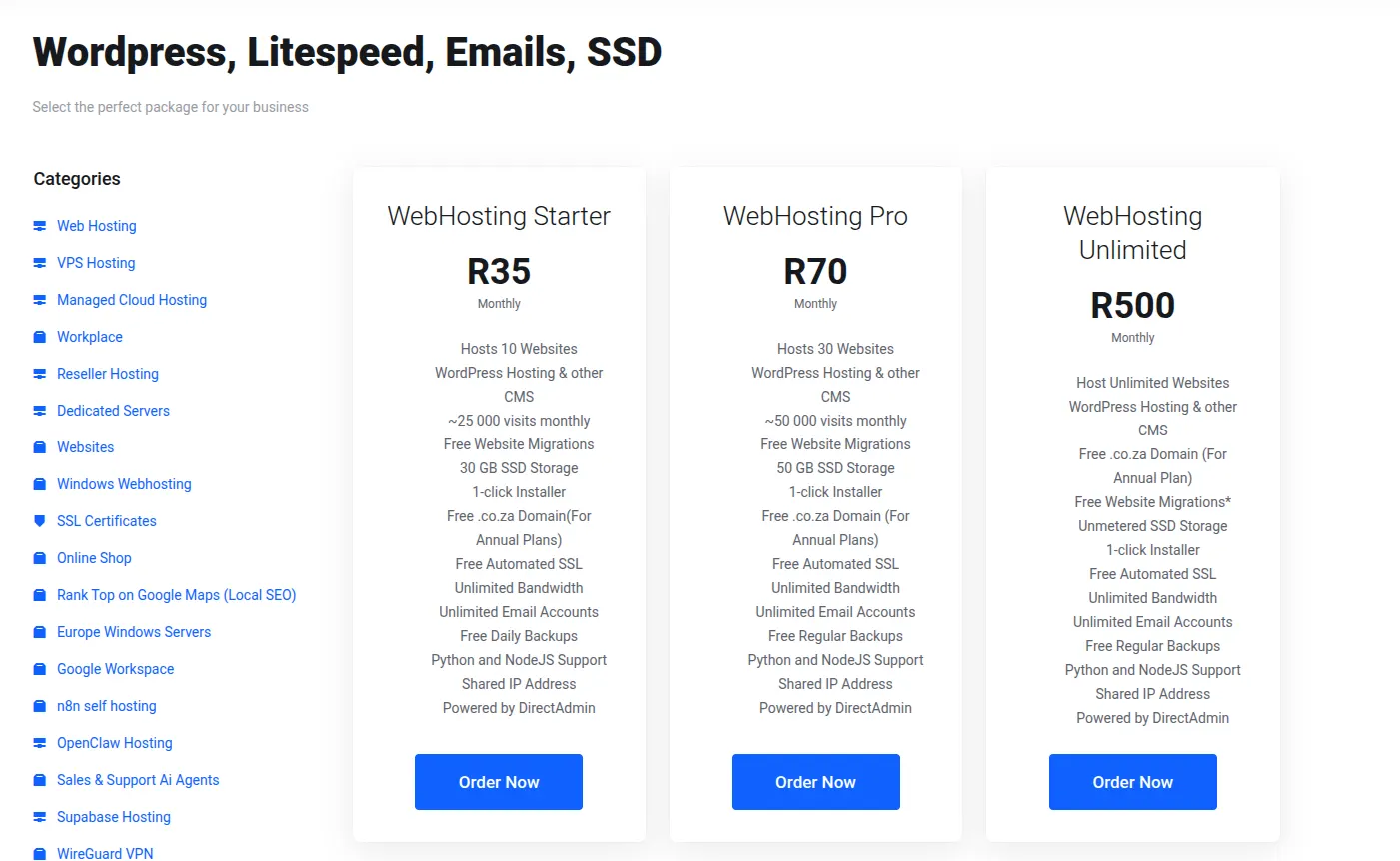
Truehost runs its infrastructure out of Johannesburg and bills in Rand, which keeps pricing predictable even when the currency wobbles against the dollar.
Every shared hosting plan, from the entry Starter tier upward, comes with unlimited bandwidth as standard, so there’s no separate unlimited tier to hunt for.
The Starter plan runs around R33 to R35 a month on a triennial commitment (closer to R400 a year), and includes 30 GB of SSD storage, which is genuinely generous for an entry-level plan in this market.
You get free SSL through Let’s Encrypt, unlimited email accounts, MySQL databases, cPanel for management, and Softaculous for one-click installs covering WordPress, WooCommerce, and Joomla among 400-plus other apps.
Free daily backups are included rather than sold as an add-on, and annual or longer plans come with a free .co.za domain.
Renewal pricing follows the same Rand-based structure rather than jumping unpredictably, and upgrading to VPS later doesn’t require rebuilding your site from scratch if you outgrow shared hosting.
Truehost’s unlimited-bandwidth hosting works well for small businesses just getting online, bloggers, portfolio sites, WordPress builds of any size, and any website with traffic that varies month to month, since there’s no fixed transfer cap to bump against during a busy period.
B) xneelo
xneelo, formerly known as Hetzner South Africa, is one of the more established names in the local hosting scene, having expanded its Johannesburg infrastructure back in 2014.
Its four shared hosting tiers, Basic, Standard, Advanced, and Master, all include unlimited monthly bandwidth as a baseline feature, along with SSD storage and daily backups.
Where xneelo differs from most competitors is its use of a proprietary control panel called konsoleH rather than cPanel, which some users find perfectly workable and others find dated compared to more familiar interfaces.
Storage and account limits scale with each tier, though xneelo doesn’t publish a single headline storage figure the way some competitors do, so it’s worth checking the specific plan you’re considering.
SSL is free, email accounts are included, and support runs 24/7, with a mix of reviews online ranging from highly satisfied long-term customers to others frustrated by slower response times.
Pricing starts noticeably higher than Truehost’s entry tier, generally landing closer to R99 a month and up depending on the plan.
xneelo suits people who value a long local track record and don’t mind paying a bit more for it, along with anyone comfortable using a non-cPanel interface.
C) Afrihost
Afrihost is one of South Africa’s most recognisable hosting brands, largely thanks to its broader work in the local broadband market.
Its Linux shared hosting plans range from the entry Silver tier upward, and Afrihost does technically describe its web traffic as unlimited, though it’s worth being precise here rather than just repeating the marketing line.
That unlimited traffic comes explicitly subject to an Acceptable Usage Policy.
If your account starts pulling meaningfully more bandwidth than a typical shared hosting site, Afrihost may ask you to move over to its Cloud Hosting product instead.
Which is a fair and fairly standard practice, but it does mean “unlimited” here isn’t quite as absolute as the word suggests.
The Silver plan costs around R84 a month but includes only 2 GB of storage, which fills up fast once you add a WordPress theme and a handful of product photos.
Realistically, most small business sites will need the Bronze Pro tier at roughly R135 a month for 8 GB instead.
Afrihost uses its own proprietary Website Control Panel rather than cPanel, free SSL is included, and a free .co.za domain comes bundled with signup.
Customer support has a mixed reputation, with award recognition on one hand and a fairly low TrustPilot score on the other.
Afrihost tends to work best for very small or brochure-style websites where the storage ceiling isn’t a concern, rather than growing ecommerce or media-heavy sites.
D) HostAfrica
HostAfrica has been operating since 1995 and runs Tier 3 ISO-certified data centres in Cape Town and Johannesburg, which gives it a genuinely African-focused footprint that’s expanded into Kenya and Nigeria as well.
Its cPanel-based shared hosting plans include unlimited bandwidth across the board, so this is a case where the word matches the actual plan terms.
The Starter plan runs from around R99 a month and includes 20 GB of SSD storage, support for two websites, up to 25 email accounts, five subdomains, and five MySQL databases.
Free SSL, free daily backups, and a free .co.za domain are all included rather than upsold separately.
Higher tiers scale up considerably, the WP Power plan, for instance, offers 100 GB of storage, three websites, and unlimited email accounts, which suits growing WordPress operations well.
Support has a strong local reputation, with reviewers regularly naming individual support staff who resolved issues directly, and HostAfrica holds a 99.9% uptime guarantee.
The main downside worth flagging is that renewal rates tend to sit noticeably higher than the introductory pricing, so it’s worth checking what year two actually costs before committing long-term.
HostAfrica is a solid fit for growing WordPress sites, small to mid-sized businesses, and anyone who wants room to scale without immediately jumping to VPS.
E) 1-grid
1-grid, formerly Gridhost, has operated out of Cape Town since 1997, making it one of the older names in this list, and it now supports tens of thousands of hosted websites.
Its Linux shared hosting plans, split into Small, Medium, and Large tiers, all advertise unlimited traffic over its fibre-optic network as a standard inclusion.
The Small plan runs around R99 a month, with storage figures reported anywhere between 2 GB and 10 GB depending on the source, so it’s worth confirming the exact current allocation before signing up, and it typically limits you to a single website.
The Medium and Large tiers step up considerably, with the Large plan offering 50 GB of storage and hosting for an unlimited number of websites.
Here’s an important catch though: while 1-grid promotes Let’s Encrypt as a free SSL option, it actually charges a separate configuration fee to activate it, which is a detail easy to miss when comparing headline prices against competitors who bundle SSL in at no extra cost.
1-grid supports both cPanel and Plesk depending on the package, and its broader product range includes company registration and website builder tools, making it more of an all-in-one business bundle than a pure hosting play.
1-grid works well for businesses that want hosting bundled alongside domain registration, professional email, and company registration under one roof, provided you factor the SSL fee into your cost comparison.
Is Unlimited Bandwidth Hosting Really Unlimited?
This is probably the most important thing to understand before you sign up for anything advertised as unlimited.
A handful of other limits can still slow your site down or get your account flagged, even when bandwidth itself isn’t the bottleneck.

1) CPU and RAM
Shared hosting servers split processing power and memory across every account on that machine.
Your site can transfer as much data as it wants and still slow to a crawl if it’s competing for CPU cycles with dozens of other busy sites sharing the same box.
2) Storage
Unlimited bandwidth is about data transfer, not disk space.
Your files, images, databases, and email all still count against a separate storage allocation, and that number is usually a fixed figure regardless of how generous the bandwidth policy is.
3) Inodes and File Limits
Less talked about, but genuinely important for sites with large numbers of small files.
Every image, cache file, plugin file, and email counts as an inode, and most hosts cap the total number you’re allowed regardless of how much raw storage space you’re using.
4) Fair-Use Policies
Nearly every unlimited plan operates under some form of Acceptable Use Policy, as we saw with Afrihost specifically.
Providers reserve the right to step in if your account starts consuming resources in a way that affects other customers on the same shared server, even if you’re technically within your bandwidth allowance.
5) Server Capacity
At the end of the day, unlimited plans still run on physical servers with finite hardware.
No provider has infinite capacity sitting behind the word unlimited, it’s a pricing and policy decision rather than a technical guarantee, which is exactly why fair-use clauses exist in the first place.
Which Unlimited Bandwidth Hosting Should You Choose?
There’s no single provider that’s the right answer for everyone here, it really comes down to what you’re building and where you’re headed.
If you’re launching a new or small website, an affordable shared plan with unlimited bandwidth is genuinely enough, and there’s no reason to overpay for resources you won’t use yet.
If you’re running a growing business, prioritise the plan with the best storage, backup frequency, and support quality rather than fixating on bandwidth alone, since that’s usually not where growing sites actually hit trouble first.
If your traffic is unpredictable, seasonal sales, viral social posts, or unpredictable referral spikes, unlimited or unmetered bandwidth genuinely earns its keep by removing one source of anxiety from the equation.
And if you’re running something resource-heavy, a large ecommerce catalog or a site with consistently high traffic, it’s worth looking at VPS or cloud hosting instead, since shared hosting’s CPU and RAM limits will likely become the real bottleneck long before bandwidth does.
For readers who want an affordable plan with unlimited bandwidth and a straightforward feature set, Truehost South Africa is worth a look, provided you double-check that the current plan terms line up with what your site actually needs before signing up.
Frequently Asked Questions
Is unlimited bandwidth really unlimited?
Not in the purest technical sense. Almost every unlimited plan operates under a fair-use policy, and other resources like CPU, RAM, and storage still have hard limits that can affect your site well before bandwidth becomes a problem.
What is the difference between unlimited and unmetered bandwidth?
Unmetered generally means the provider doesn’t measure or cap your data transfer at all, provided usage stays reasonable for a shared hosting account. Unlimited is often used interchangeably, but both terms typically come with an underlying fair-use policy, so it’s worth reading a provider’s terms rather than assuming the words mean something absolute.
Is unlimited bandwidth good for WordPress?
Yes, particularly for WordPress sites with image-heavy pages or plugins that generate extra traffic, since you won’t need to monitor a transfer cap. Just remember that WordPress performance depends just as much on CPU, RAM, and caching as it does on bandwidth.
Is unlimited bandwidth good for ecommerce?
It helps, especially for stores with product image galleries and seasonal traffic spikes, but ecommerce sites also lean heavily on database performance and storage, so those factors deserve equal attention when comparing plans.
Does unlimited bandwidth mean unlimited storage?
No, these are two separate resources entirely. A plan can offer unlimited bandwidth while still capping your storage at a fairly modest figure, so always check both numbers independently.
Can unlimited bandwidth hosting handle high traffic?
Shared hosting with unlimited bandwidth can handle moderate traffic growth reasonably well, but consistently high traffic usually runs into CPU and RAM ceilings on shared servers regardless of the bandwidth policy. At that point, VPS or cloud hosting becomes the more sensible option.
How much does unlimited bandwidth hosting cost in South Africa?
Entry-level plans with unlimited bandwidth generally start anywhere from around R33 a month on longer billing terms up to roughly R100 a month or more, depending on the provider, storage allocation, and contract length you choose.
Does Truehost offer unlimited bandwidth hosting?
Yes, unlimited bandwidth is included as standard across Truehost South Africa’s shared hosting plans, starting from the entry Starter tier.
When should I upgrade from shared hosting to VPS?
Generally once your site consistently strains CPU or RAM limits, experiences slowdowns during traffic spikes despite unlimited bandwidth, or needs more control over server configuration than shared hosting allows. If you notice performance issues even though your bandwidth usage looks fine, that’s usually the sign it’s time to move up.