 Web Hosting
 Windows HostingBuilt for Windows apps and websites – stability, speed and flexibility
 Reseller HostingLaunch a hosting business without technical skills or expensive infrastructure
 Affiliate ProgramRefer customers and earn commissions from sales across our platform
 Domain SearchFind and secure a domain name in seconds with our quick lookup tool
 CO ZA Domains
 All DomainsExplore domain names from over 324 TLDs globally – all in one place
 Free Whois Lookup Tool South Africa
 VPS
VPS Website Builder
 Online ShopSet up a sleek eCommerce store with zero coding knowledge
 SSLs
SSLs SupportAccess help articles, how-tos, and everything about our services
 Blog
Blog Contact UsReach our team instantly via live chat or drop us an email
Your online store crashes during a payday sale. Orders stop coming in. Customers leave the checkout page and don’t come back.
A slow checkout costs more than a lost sale. It costs trust, and trust takes time to rebuild. A compliance officer might ask where your customer data is physically stored, and a shared server rarely provides a clear answer.
A dedicated server solves a specific set of these problems, not every problem a growing business faces.
This guide breaks down which South African businesses actually need one. It also flags where a dedicated server is the wrong tool for the job.
Table of Contents
When a Dedicated Server Actually Makes Sense
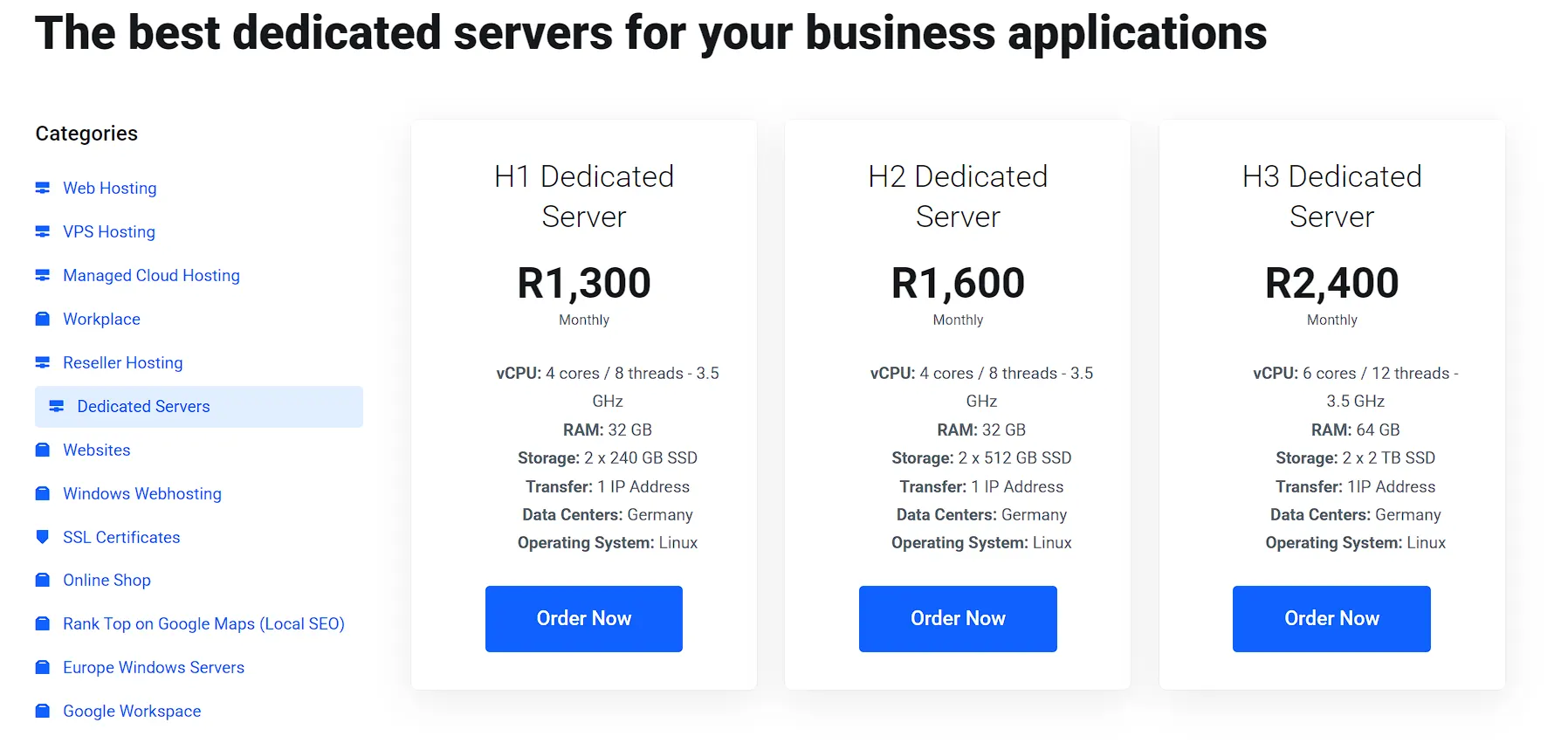
A dedicated server gives you an entire physical machine, with no other tenant sharing its CPU, RAM, or storage.
Shared hosting splits one server across hundreds of accounts, so performance drops when neighbors spike.
A VPS sits between the two, offering isolated resources on a slice of a shared physical machine.
The signal to move up is simple. Your traffic or workload has grown past what a VPS can handle without slowing down. South Africa adds two local factors on top of that signal.
- Sustained load: your site or app strains under normal traffic, not just rare spikes
- POPIA data residency: your business needs customer data physically stored inside South Africa
- Local connectivity: Johannesburg and Cape Town both connect to NAPAfrica, reducing the number of hops for South African users.
- Budget reality: a dedicated server costs more than a VPS, so the upgrade should match a real need
The sections below match ten common use cases to the specs and local details that fit each one.
1) High Traffic Ecommerce and Retail Platforms
A shared checkout flow buckles during a flash sale or a payday spike. Database queries queue up, pages time out, and shoppers abandon their carts.
A dedicated server removes the shared bottleneck and gives your store its own resources during peak hours.
- NVMe storage speeds up cart and inventory database reads during high order volume.
- RAID configuration protects order and customer data if a drive fails mid-sale
- ZAR pricing keeps hosting costs predictable, without exchange rate swings hitting your budget
- Payment gateway latency improves when your server sits close to South African banks.
Skip this upgrade if your traffic stays steady and low. A VPS handles most small stores without trouble, and a dedicated server adds cost you may not need yet.
2) Fintech and Payment Processing
Fintech platforms carry a compliance load that ecommerce sites don’t face. POPIA sets strict rules for how personal data gets collected, stored, and processed.
Hosting inside South Africa simplifies that compliance work. Routing payment data through servers in Europe or the US adds legal risk that a local dedicated server avoids.
- ECC RAM catches and corrects memory errors before they corrupt a transaction record
- Dedicated bandwidth keeps latency low and predictable during payment authorization requests.
- Physical location control gives your compliance team a clear answer for data residency audits.
- Uptime guarantees matter more here because downtime in a payment system immediately halts revenue.
A content site can absorb a few minutes of downtime. A payment platform cannot, and that gap in risk tolerance justifies the extra cost.
3) Gaming and Real-Time Applications
South African gamers have asked for local game servers for years. Pinging a server in Europe often takes more than 180 milliseconds, which shows up as lag during fast gameplay.
A dedicated server hosted in Johannesburg or Cape Town cuts that round-trip significantly.
- High single-core clock speed keeps game logic and physics calculations fast and consistent.
- Low-contention bandwidth avoids the slowdowns that shared hosting causes during peak player counts.
- DDoS protection should come standard, since gaming servers are a common target for DDoS attacks.
- Regional peering through Johannesburg or Cape Town data centers cuts ping for local players.
This upgrade pays off once player counts or tick rate demand outgrow what a VPS can sustain. A small private server for a handful of friends rarely needs it.
4) SaaS Platforms and Enterprise Applications
Multi-tenant SaaS platforms need compute that stays available to every customer, all the time. A VPS can burst under load, but that burst isn’t guaranteed.
A busy customer can slow down every other tenant on the same box. A dedicated server removes that risk by giving the platform its own hardware.
- Adjustable RAM tiers let you size memory to your actual tenant count and usage.
- Hardware or software RAID protects tenant data across drives, with built-in redundancy.
- Time zone-aligned support cuts response time when something breaks during South African business hours.
- ZAR billing removes currency risk from your monthly infrastructure cost
Watch for the growth signals before you move. Rising response times and frequent resource limit warnings are early signs. Customer complaints about slow load mean a VPS has reached its ceiling.
5) Government, Healthcare, and Regulated Data
Government agencies and healthcare providers face POPIA obligations that go beyond those of most businesses. Physical control over where data resides is often non-negotiable for these sectors.
Regulators expect a clear chain of custody. A dedicated server hosted in a certified South African data center directly meets that requirement.
- Certified facilities with ISO or PCI DSS certifications provide auditors with a documented compliance trail.
- Controlled access hardware limits who can physically touch the server and its stored data
- Backup electricity systems at the data center level, checked as part of due diligence, not taken on faith.
- Uptime guarantees in writing, since a regulated service going offline carries its own legal exposure.
This use case prioritizes compliance and control over raw speed. A slightly slower server that meets every regulatory box still beats a fast one that doesn’t.
6) Media Streaming and High Bandwidth Content
Buffering kills viewer retention faster than almost anything else. A shared or lightly resourced server chokes under the bandwidth demands of video streaming.
A live event makes that strain worse. While a dedicated server with a high bandwidth uplink keeps playback smooth for every viewer at once.
- High bandwidth uplink, from 1 Gbps up to 10 Gbps, depending on your audience size
- Unmetered or high traffic allowances prevent surprise overage charges during a viral moment.
- Cape Town’s Atlantic-facing connectivity helps if your audience splits between local and international viewers.
- Bandwidth cost comparison against cloud egress fees, since streaming at scale gets expensive fast on the cloud.
Run the numbers before you commit. A dedicated server often costs less than cloud bandwidth once your streaming volume passes a certain point.
7) AI, Machine Learning, and Rendering Workloads
Renting GPU compute overseas means paying in dollars, waiting for cross-border latency, and sending training data outside South Africa.
A local GPU dedicated server removes all three problems at once. Your data stays in the country, and your billing stays in Rand.
- High VRAM GPUs, in the 24GB to 96GB range, sized to the models you train or run
- NVMe storage speeds up dataset loading during training and inference jobs
- 10Gbps connectivity supports distributed jobs and large dataset transfers without bottlenecks
- POPIA-aligned deployment keeps enterprise LLM and internal chatbot data under your own control
This use case fits AI researchers fine-tuning open-weight models, and creative studios rendering in Octane or Redshift. It also fits enterprise teams running private LLMs on internal company data.
8) Forex and Financial Trading Platforms
A home trading setup fails at the worst possible moment. Electricity outages and internet connection drops leave open positions unmanaged, and automated strategies stop running mid-trade.
A dedicated server hosted in a facility with backup electricity keeps your platform online through a local blackout.
- High single-core clock speed since MT4 and MT5 run most operations on one core
- Windows Server environment, since most trading platforms and Expert Advisors are built for it
- Dedicated IP address, which many brokers require for consistent trade execution routing
- Data center backup electricity absorbs the exact grid instability that South African traders most often cite.
Skip this if you trade manually and occasionally check charts. A dedicated server earns its cost for traders running Expert Advisors around the clock.
9) Web Agencies and Hosting Resellers
Agencies managing a growing roster of client sites outgrow shared reseller plans fast. Slow load times on one client’s site are starting to affect every other account on the same shared box. A dedicated server gives an agency its own hardware to host every client account on.
- WHM and cPanel access at the root level, giving full control over every hosted account
- NVMe storage sized for volume, since many isolated client accounts add up quickly
- White label branding, so clients see your agency’s name, not the hosting provider’s
- Recurring revenue model, since agencies resell hosting capacity under their own pricing and brand
Move to this tier once shared reseller plans start throttling performance across multiple client sites. Below that point, a shared reseller account usually covers the need.
10) Backup, Disaster Recovery, and Business Continuity
A backup stored on the same server as your production data protects against almost nothing. If that server fails, both copies disappear together.
A separate dedicated server, ideally in a different location, gives your business a real recovery point.
- RAID or redundant storage on the backup server itself, so the safety net doesn’t have a single point of failure
- Scheduled offsite backup routing, moving copies away from the primary server on a set schedule
- Uptime SLA is separate from the primary server, so a shared outage doesn’t take down both.
- Local electricity instability makes disaster recovery an operating requirement in South Africa, not an optional extra.
This use case often runs alongside another one on this list. Both a fintech platform and an ecommerce store need a backup target on top of their main server.
Dedicated Server vs VPS: A Quick Decision Check
Three questions cut through most of the decision. Answer them honestly, and the right infrastructure choice usually becomes clear.
- Does your workload run under sustained load, not just occasional spikes?
- Does a compliance rule require your data to remain within South Africa and under your own physical control?
- Does your budget support the higher monthly cost of a dedicated server?
Every use case above sits somewhere on that spectrum. Ecommerce, fintech, gaming, SaaS, and streaming rely most heavily on the sustained load question.
Government, healthcare, and fintech rely most heavily on the compliance question. Forex trading and disaster recovery lean on electricity resilience above all else.
FAQs
Can a dedicated server handle load shedding and electricity outages?
A dedicated server itself doesn’t stop the electricity from cutting out in your office. Its value comes from where it’s hosted, inside a data center with backup generators and battery systems. That keeps your server online even during a local outage at your business address.
How much does a dedicated server cost in South Africa?
Pricing depends heavily on the hardware you need. Entry-level configurations start in the low hundreds of dollars per month. High-end setups with large RAM run well past a thousand. GPU servers and enterprise setups sit at the higher end of that range.
How long does it take to set up a dedicated server in South Africa?
Standard configurations often go live within 12 hours of ordering. Custom builds, or specific hardware requests, can take a few days longer. Check the exact timeline with your provider before you commit to a launch date.
Is a dedicated server worth it for a small business?
Not always. A small business with steady, low traffic usually gets everything it needs from a VPS at a lower cost. The upgrade makes sense once traffic, compliance needs, or workload demands outgrow what a VPS can reliably handle.
Get Dedicated Server Hosting Today
The right infrastructure choice comes down to matching the use case to the actual workload. Chasing the biggest spec sheet rarely helps.
A fintech platform, a gaming server, and a media streaming service all need very different things from a dedicated server. Ten use cases sit on very different points of that spectrum.
If you’re still unsure which tier fits your business, run a spec comparison. Match it against your actual traffic and compliance needs.
Talk to a hosting provider with local South African infrastructure. Size the plan to the workload in front of you, not next year’s.