 Web Hosting
 Windows HostingBuilt for Windows apps and websites – stability, speed and flexibility
 Reseller HostingLaunch a hosting business without technical skills or expensive infrastructure
 Affiliate ProgramRefer customers and earn commissions from sales across our platform
 Domain SearchFind and secure a domain name in seconds with our quick lookup tool
 CO ZA Domains
 All DomainsExplore domain names from over 324 TLDs globally – all in one place
 Free Whois Lookup Tool South Africa
 VPS
VPS Website Builder
 Online ShopSet up a sleek eCommerce store with zero coding knowledge
 SSLs
SSLs SupportAccess help articles, how-tos, and everything about our services
 Blog
Blog Contact UsReach our team instantly via live chat or drop us an email
Magento is a powerful e-commerce platform. It needs plenty of RAM, CPU power, and fast storage to keep your store running smoothly.
Adobe now calls it Adobe Commerce. But it still runs on the Magento codebase.
Choosing the right Magento VPS hosting provider is more important than it does for a simple blog or business website.
A VPS gives you dedicated resources, full root access, and room to grow. It is also a flexible and cost-effective hosting option.
South African store owners have unique needs. They need local data centres for faster performance.
ZAR billing helps avoid currency swings. Reliable infrastructure keeps stores online, even during power outages.
Eskom has gone more than 300 days without load shedding as of early 2026. But experts say power cuts could return in 2027 or 2028. A reliable VPS helps keep your store online, just in case.
This guide reviews six Magento Hosting VPS providers for the South African market. It compares their pricing, features, and pros and cons.
Table of Contents
Magento Hosting VPS Providers Comparison Table
| Provider | Starting Price | Magento Install Method | Management Type |
|---|---|---|---|
| Truehost | R80–400/mo (unmanaged) / R120–640/mo (managed) | Manual/scripted via root access | Both self-managed and managed |
| HostAfrica | R130–430/mo (Linux VPS) / R1,485/mo (managed) | Softaculous 1-click on cPanel/DirectAdmin | Both self-managed and managed |
| Domains.co.za | R209/mo (Linux VPS) / R2,999/mo (managed cPanel) | Softaculous 1-click | Both |
| telaHosting | R560–1,612/mo (tiered) | Managed setup via cPanel | Fully managed |
| EliteHost | R129/mo (entry VM1) | Manual or Softaculous/cPanel add-on | Self-managed (cPanel optional) |
| Xneelo | From ~R99/mo (shared) | Not recommended for new installs | Self-managed |
A quick way to read this table: if you want the lowest entry cost with local support, start with Truehost. Note that the prices are as of july 2026. Always confirm with the provider.
1) Truehost
We at Truehost support Magento directly, alongside WordPress, Joomla, and Drupal.
You get an unmanaged Linux VPS with 1-click apps and full root access for manual or scripted Magento installs.
Features
- Explicit Magento support alongside other major CMS platforms
- Full root access for manual or scripted installs
- Managed VPS tier for those who want less hands-on server work
- South African data centre presence for lower latency
- SSD/NVMe storage with scalable resources
- cPanel/WHM available on select plans
Pricing
- Unmanaged VPS: R80–400/month, scaling with vCPU, RAM, and storage
- Managed VPS: R120–640/month, with management included
- Cloud hosting options also available
Known for
Truehost is known for an affordable entry point with local presence built in. It’s a practical pick for new or small-to-medium Magento stores.
If your store needs more power or advanced management, you may need a bigger plan.
But for most small and medium-sized businesses, this is a great place to start. You can register your domain with us and launch a Magento VPS without stretching your budget.
Our support team is based in South Africa. That means you can get help quickly if your checkout goes down late at night.
2) HostAfrica
HostAfrica supports Magento through cPanel or DirectAdmin on its managed VPS tier. Softaculous handles the 1-click install, which saves time on setup.
Features
- Magento support via cPanel or DirectAdmin (managed VPS)
- Softaculous 1-click Magento installation
- LiteSpeed available as an optional performance add-on
- SSD storage built for e-commerce workloads
- Self-managed Linux VPS option for full control
Pricing
- Self-managed Linux VPS: from R130–430/month
- Managed VPS: from R1,485/month
- Billing options: monthly, quarterly, biennially, or annually
- Add-ons: extra resources, control panel licences, LiteSpeed, Softaculous
Popular for
HostAfrica is known for scalable, high-availability local hosting with strong support documentation.
It isn’t a dedicated Magento-branded host. But once you set up Softaculous with cPanel or DirectAdmin, it handles Magento well, and their support team can help with the setup.
The billing flexibility here is a genuine plus. Locking in biennial or annual billing can meaningfully lower your monthly rate if your store’s cash flow allows it.
3) Domains co za
Domains.co.za bundles Softaculous into its VPS plans for 1-click Magento installs. It also calls out Redis caching support directly, which is important for Magento performance.
Features
- Softaculous auto-installer with 1-click Magento install
- Redis caching support explicitly called out as beneficial
- Linux VPS with full root access, plus cPanel options
- NVMe/SSD storage for performance
Pricing
- Linux VPS: from R209/month
- Managed cPanel VPS: from R2,999/month (higher-tier managed)
- Add-ons: cPanel license from around R420+, plus extra CPU/RAM/storage
Best for
This is one of the quickest paths to a working Magento setup. Developers and agencies who want speed without heavy manual configuration tend to favour it.
Redis caching is important for Magento. It stores sessions and caches data to improve performance.
Without it, your admin panel and checkout can slow down when traffic increases.
4) telaHosting
telaHosting runs a managed VPS built around LiteSpeed, which is a strong fit for Magento’s performance needs. Everything here is hands-off by design.
Features
- Managed VPS with LiteSpeed web server
- CloudLinux and Imunify360 for stability and security
- Unlimited cPanel accounts, useful for multi-store operators
- NVMe storage with dedicated resources and included migrations
- Stack optimised for business and e-commerce workloads
Pricing
- VPS Core: ~R560/month
- VPS Edge: ~R945/month
- VPS Boost: ~R1,248/month
- VPS Max: ~R1,612/month
Fit for
telaHosting appeals to store owners who’d rather not touch server configuration at all. You pay more, but you get a modern, managed stack out of the box.
If you run several Magento stores under one account, the unlimited cPanel accounts on this plan can offset the higher entry price quickly.
5) EliteHost
EliteHost leans on raw hardware. AMD EPYC processors and PCIe NVMe storage give it real headroom for high-traffic stores.
Features
- High-performance hardware: AMD EPYC + PCIe NVMe
- Unmetered bandwidth, useful for traffic spikes during sales
- Full root access, with manual install or Softaculous/cPanel add-on
- Unlimited domains and traffic
Pricing
- Entry VPS (VM1): ~R129/month (1 vCPU, 2GB RAM, 25GB NVMe, unmetered)
- Mid-range (VM3): ~R319/month
- Higher plans scale into the thousands of rand
Stands Out for
EliteHost is known for raw performance and headroom for high-traffic Magento stores. You get less hand-holding than a fully managed plan, so it suits technical teams best.
Unmetered bandwidth is worth calling out on its own. Flash sales and Black Friday spikes are exactly when a metered plan can blindside you with overage charges.
6) Xneelo
Xneelo officially supports existing Magento installations. New setups are actively discouraged.
Features
- Officially supports existing Magento installations only
- New setups discouraged due to compatibility and maintenance challenges
- Self-managed server options for full control
Pricing
- Shared hosting from ~R99/month; cloud/VPS pricing runs higher
- Not positioned around new Magento deployments
Made for
Xneelo suits stores already running on Magento rather than fresh installs. If you’re launching a new project, you’re generally better served elsewhere on this list.
This isn’t a knock on Xneelo’s infrastructure. It’s simply not positioned or optimised for Magento’s specific demands the way the other providers here are.
Sizing Guidance for Magento VPS
Getting your resource sizing right from day one saves you a painful mid-year upgrade.
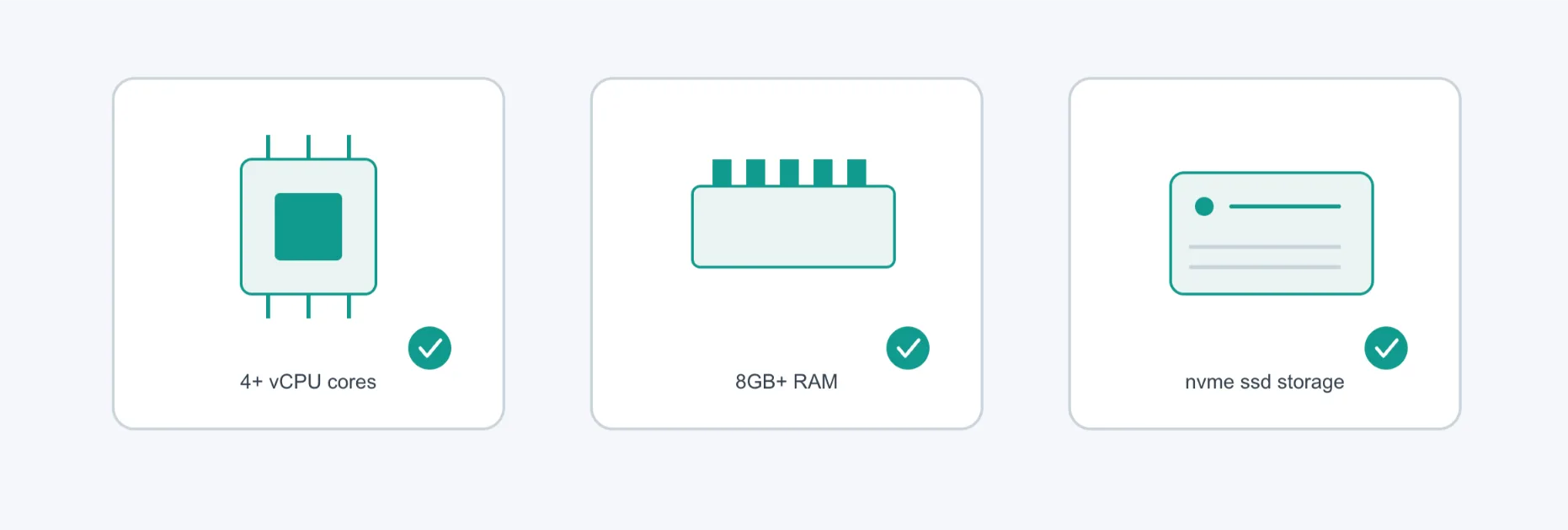
- Recommended baseline for small-medium stores: at least 4 vCPU, 8GB+ RAM, NVMe storage
- Managed options, like telaHosting or
Domains.co.za‘s managed tier, reduce hands-on maintenance but cost more - Self-managed options suit technical users comfortable with server administration
Why this is important: Adobe recommends a minimum of 2 GB of PHP memory. In reality, most Magento stores need more to support extensions, cron jobs, and customer traffic. A VPS that’s too small can lead to slow performance and checkout issues.
A few other sizing tips worth keeping in mind:
- Separate your database from your web server once your catalog passes a few thousand SKUs. This keeps indexing from competing with storefront traffic for CPU.
- Run Varnish for full-page caching. It’s not optional at scale — cached pages can load 5 to 10 times faster than uncached ones.
- Choose NVMe over standard SSD where the price difference is small. Magento reads and writes thousands of small files, and NVMe’s speed advantage adds up fast.
- Review your resource usage every quarter. Traffic and catalog size both grow, and it’s cheaper to upgrade proactively than to firefight during a sale.
Get Magento Hosting With Truehost VPS
You don’t need to guess your way through Magento hosting. We at Truehost give you local South African infrastructure, ZAR pricing, and root access from day one.
Choose to manage your own server or let us do it for you. Our VPS plans grow with your business, from your first store to a large multi-store catalog. Open your Magento VPS today and get your store online with ease.
Magento Hosting VPS Providers FAQs
Is Magento cheaper than Shopify?
Not necessarily. Shopify bundles hosting into its monthly subscription, so there’s no separate VPS to manage. Magento Open Source has no license fee, but you pay for hosting, development, and maintenance separately, which can be cheaper or more expensive depending on your store’s size and how much custom work you need. For simple stores, Shopify is usually the lower-effort and lower-cost option. For complex, high-SKU stores that need full control, Magento on the right VPS often works out more cost-effective long term.
Does anyone still use Magento?
Yes. Estimates vary by source, but StoreLeads counted roughly 119,000 live Magento stores in late 2025, while W3Techs put the figure closer to 130,000. Magento still holds an estimated 8% share of the global e-commerce platform market, sitting behind Shopify and WooCommerce. Store counts have declined over the past year as smaller merchants move to simpler platforms, but Magento remains the leading choice for B2B and high-SKU enterprise stores.
Which is better, Magento or WooCommerce?
It depends on your store’s complexity. WooCommerce is easier to set up and cheaper to run for smaller catalogs, since it sits on top of WordPress. Magento wins when you need deep customisation, complex B2B pricing rules, multi-store setups, or a catalog that’s outgrown what a plugin-based platform can handle. Magento also demands more from your hosting, which is exactly why VPS resources are important here.
How much does Magento cost per month?
Magento Open Source itself is free to download, so your monthly cost comes down to hosting, development, and maintenance. Budget-conscious self-managed VPS hosting in South Africa starts under R500/month, while managed Magento hosting typically runs higher once support and performance tuning are included. If you move to Adobe Commerce, the paid enterprise edition, licensing alone starts at roughly $22,000 per year and scales with your store’s revenue, on top of hosting costs.