 Web Hosting
 Windows HostingBuilt for Windows apps and websites – stability, speed and flexibility
 Reseller HostingLaunch a hosting business without technical skills or expensive infrastructure
 Affiliate ProgramRefer customers and earn commissions from sales across our platform
 Domain SearchFind and secure a domain name in seconds with our quick lookup tool
 CO ZA Domains
 All DomainsExplore domain names from over 324 TLDs globally – all in one place
 Free Whois Lookup Tool South Africa
 VPS
VPS Website Builder
 Online ShopSet up a sleek eCommerce store with zero coding knowledge
 SSLs
SSLs SupportAccess help articles, how-tos, and everything about our services
 Blog
Blog Contact UsReach our team instantly via live chat or drop us an email
You are about to launch, cash is tight, and Gmail is sitting right there, free and familiar.
The question is whether that free account can actually carry a real South African business, or if it quietly costs you more than the domain fee you are trying to avoid.
Here is the honest answer about free business email in South Africa.
Global providers like Gmail and Outlook work fine on every South African mobile network, MTN, Vodacom, Telkom, and Rain included, and cost nothing to set up.
The catch is not technical; it is about what a free address signals to a customer and if it holds up under South African data protection law once your business starts collecting information from real people.
Table of Contents
The Quick Verdict
Free email works for testing an idea, for a genuinely zero-budget first few weeks, or for informal freelance gigs where personal rapport matters more than corporate polish.
It stops being enough the moment you are invoicing clients, collecting customer data, or trying to look like a business people can trust with their money.
For most operating South African businesses, a custom .co.za address is the better call, and the cost gap is smaller than it feels.
This is not a universal rule that applies identically to every business from day one.
It is a threshold you cross, and recognizing exactly when you cross it matters more than picking a side before you actually need to.
At a Glance
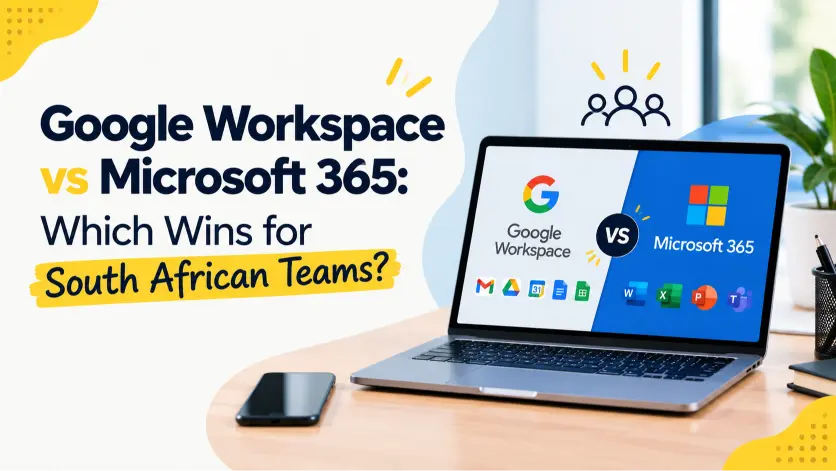
Here is how the two options actually compare once you set aside the price tag and look at what each does for your business day to day.
| Free Email (Gmail/Outlook) | Custom .co.za Email | |
| Cost | R0 | Domain under R100/year + hosting |
| Branding | Promotes Google or Microsoft’s domain | Promotes your business in every email |
| Customer trust | Reads as informal or temporary | Signals an established local business |
| POPIA compliance | Limited data privacy controls | Better compliance features with paid hosting |
| Team growth | One address, hard to scale | Add sales@, support@ as you hire |
| Deliverability | Generally solid for personal use | Better suited to invoices and client mail |
When Free Actually Works
Free is not automatically the wrong answer.
It depends entirely on where your business actually is right now, and a few specific situations make it a genuinely reasonable choice rather than just a shortcut.
Testing an idea
You are validating whether anyone will buy your product before committing to anything.
A free address is completely reasonable here, since spending money on infrastructure before you have a single customer is backwards.
Genuinely zero budget
Some businesses launch with nothing in the account for the first few weeks.
If that is your real situation, a free email buys you time without adding a bill you cannot cover yet.
Informal freelance work
Small, personal gigs where a client already knows you and rapport matters more than a polished corporate image.
A branded address adds little here if the relationship is already personal and direct.
Where Free Starts Costing You
- Client-facing invoicing: a quote from [email protected] appears less established than one from [email protected], and first impressions shape whether a client pays on time.
- Collecting customer data: POPIA requires a lawful basis and reasonable safeguards for personal information, and paid business email hosting generally offers stronger compliance controls than a free consumer account.
- Growing past one person: a free account gives you one address. The moment you need sales@ or support@ routing to different people, you have outgrown it.
- Anything where trust affects conversion: bookings, deposits, or repeat business all lean on the customer believing you are a real, ongoing operation.
None of these costs appear as line items on a bill, which is exactly why they are easy to underestimate.
For example,a client who quietly decides not to book because your address looked informal never tells you that is why.
They just do not come back, and that silent drop-off is far harder to diagnose than a missed payment or a bounced email.
The Cost of Going Professional
A .co.za domain typically costs under R100 a year, and basic business email hosting from a local South African provider adds only a modest monthly fee.
Measured against what a single lost client or a POPIA compliance gap could cost, this is one of the cheapest upgrades available to a small business.
The gap between free and paid isn’t really a cost gap when you look at it this way.
It is closer to the price of a single coffee each month, in exchange for an address that promotes your own business instead of Google’s or Microsoft’s in every message you send.
Worth noting, too: older local free webmail options like Webmail.co.za have largely moved to paid subscriptions.
So, the honest comparison today is Gmail or Outlook’s genuinely free global accounts against a locally hosted .co.za address, not free local versus paid local.
Once you compare it that way, the decision usually comes down to branding and compliance rather than price.
Which One Fits You?
Solo tester with zero customers
Stay free for now. Revisit this once you have your first paying client or send your first invoice.
Spending on infrastructure before you have proven anyone wants what you are selling is money better saved.
Freelancer with a personal client base
Free can still work if your relationships are already personal and direct.
A branded address becomes worth it once you start pitching cold or invoicing larger clients who have never met you in person.
Small team or registered business
Move to a custom domain now. The POPIA exposure and the credibility gap both compound the longer you wait, and the cost of switching only grows as your client list grows.
Every new client onboarded on a free address is one more contact to update later.
Growing business adding staff
A custom domain is no longer optional at this stage. You need role-based addresses, and a free account cannot provide that structure without requiring every new hire to share a single login.
What POPIA Actually Requires
The Protection of Personal Information Act applies the moment your business collects a customer’s name, email address, or payment details, regardless of company size.
It requires a lawful basis for holding that data and reasonable technical safeguards to protect it from loss or unauthorized access.
A free consumer email account was never built with this in mind, since Gmail and Outlook are designed for personal use, not for South African business compliance obligations.
Paid business email hosting typically includes:
- Stronger access controls
- Audit trails
- Data-handling practices that align far more closely with POPIA’s expectations for businesses handling customer information.
This does not mean free email is automatically illegal to use, but it does mean the compliance burden sits more heavily on you to manage manually if you stick with it.
In practice, this shows up as small habits that most business owners never think to set up on a free account:
- Who else has access to the inbox
- How old client emails are archived or deleted
- If a lost or stolen device could expose customer data
A properly configured business email plan handles much of this by default, rather than leaving it to whoever initially set up the account.
The Branding Effect You Are Giving Away
Every email sent from a free account is a small, repeated advertisement for someone else’s business.
A message from [email protected] puts Google’s brand in front of your customer in the same visual space where your own business name should be building recognition instead.
Over dozens or hundreds of emails a month, that repetition adds up.
A custom domain flips this entirely, so every quote, every reply, and every invoice quietly reinforces your own business name instead of a free provider’s.
This is a small effect in any single email, and a meaningful one compounded across a year of client communication.
This is especially for a business that relies on referrals and word of mouth to grow.
What Are You Still Waiting For?
Free email is not a bad choice; it is a starting point with a clear expiry date.
The moment your business starts asking customers to trust it with money or personal information.
That free account works against you in ways that are easy to underestimate until a client mentions it.
The decision rarely needs to be dramatic or immediate.
Most businesses can start free, watch for the signals covered above, missed bookings, a client who hesitates over an invoice, or your first real POPIA obligation, and switch the moment one of those shows up rather than waiting for all of them to pile up at once.
If you are past the testing stage, our business email plans get you onto a proper .co.za address, with room to add sales@ or support@ as you grow, for less than the cost of the trust you are currently leaving on the table.