 Web Hosting
 Windows HostingBuilt for Windows apps and websites – stability, speed and flexibility
 Reseller HostingLaunch a hosting business without technical skills or expensive infrastructure
 Affiliate ProgramRefer customers and earn commissions from sales across our platform
 Domain SearchFind and secure a domain name in seconds with our quick lookup tool
 CO ZA Domains
 All DomainsExplore domain names from over 324 TLDs globally – all in one place
 Free Whois Lookup Tool South Africa
 VPS
VPS Website Builder
 Online ShopSet up a sleek eCommerce store with zero coding knowledge
 SSLs
SSLs SupportAccess help articles, how-tos, and everything about our services
 Blog
Blog Contact UsReach our team instantly via live chat or drop us an email
Your .co.za domain shows as expired, and your site no longer loads. Your email has stopped too. Every day you wait pushes you closer to permanent deletion.
The fee to save the domain climbs at each stage. The good news is that ZARC, the registry operator for .za domains, runs a fixed five-stage timeline after expiry.
Once you know which stage you’re in, you know exactly what to do next and what it will cost.
Table of Contents
What Happens the Moment Your .co.za Domain Expires
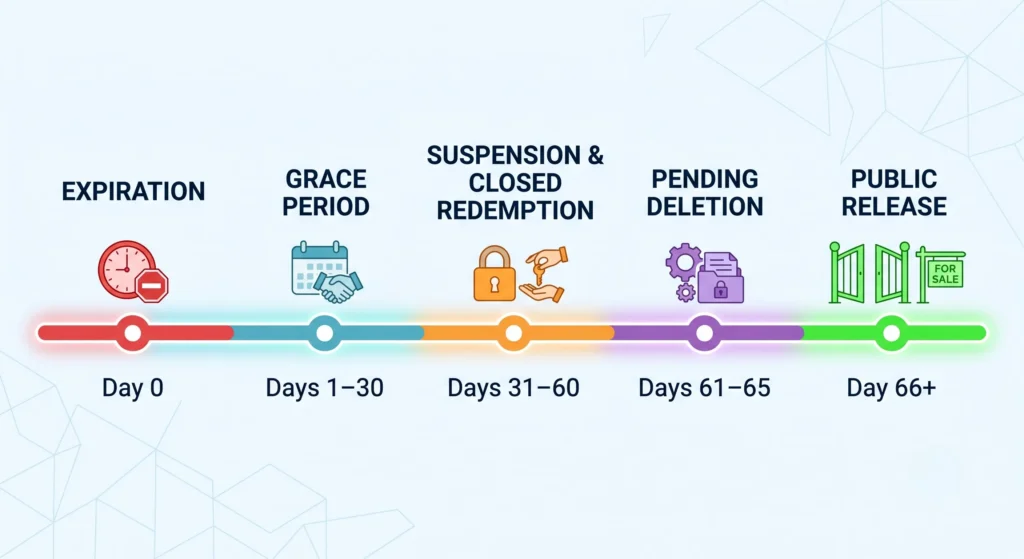
Expiry does not mean instant deletion. It starts a fixed clock managed by ZARC. That clock runs through five stages before the domain becomes available again.
- The five stages run in this order: grace, pending update, pending suspension, pending deletion, and closed redemption. Each stage has a set number of days attached to it. ZARC publishes these numbers directly, so the timeline never depends on guesswork.
- During several of these stages, your website and email stop working, even though you technically still hold the domain. The domain still belongs to you on paper, but visitors and email servers can no longer find it. The DNS records stop resolving partway through the process.
- Each stage carries its own rules for cost and recovery. The stage you’re in determines what you pay to get the domain back. It also determines how quickly you need to move before the next stage begins.
The 7-Day Grace Period (Days 1 to 7)
ZARC sets the grace period at 7 consecutive days from the date of expiry. This is the cheapest and simplest way to act.
Renewing during these 7 days costs only the standard renewal fee. No extra redemption charge applies. The domain picks up exactly where it left off, with no gap in ownership or billing history.
Some registrars add their own internal grace window on top of ZARC’s clock. That’s why the quoted number of days can vary by host. Check with your specific registrar rather than assuming every provider follows the same 7-day figure.
Reinstating within this window lets the domain continue as if nothing happened. Your DNS settings, email routing, and existing configuration stay intact, so there’s no rebuilding work once the renewal goes through.
Pending Update, Suspension, and Deletion Periods (Days 8 to 22)
Once the grace period closes without a renewal, the domain moves through three back-to-back stages, each lasting 5 days.
The pending update period comes first and marks the point where ZARC’s cancellation process formally begins. This stage acts as the registry’s first internal flag. It signals that the domain has missed its window and is now counting down toward suspension.
The pending suspension period follows, and this is typically where your site and email stop resolving completely. Visitors get an error instead of your homepage. Any inbound email tied to the domain starts bouncing back to the sender.
The pending deletion period comes last. Reinstating here applies your renewal billing retroactively, as though the domain never lapsed. You settle every fee that has built up during the lapse in one payment.
The 20-Day Closed Redemption Period (Days 23 to 42)
If the domain still isn’t renewed after the pending deletion period, it enters closed redemption for 20 days. This is the final chance to recover it before deletion.
ZARC’s live-environment policy sets this window at 20 days. It stands as the last formal opportunity to reclaim the domain before it returns to the public pool.
Reinstating during closed redemption charges a full redemption fee on top of the standard renewal fee. Registrars set their own redemption fee within ZARC’s framework, so the exact amount depends on which host manages your account.
A successful reinstatement here resets the domain for a fresh one-year term, regardless of your original registration length. That means even a domain you registered for five years restarts on a fresh twelve-month cycle once redeemed.
Add up every stage, and you get 42 days total, from expiry to final deletion. That figure gives you a clear outer limit for how long you have before the domain is gone for good.
What Redemption Actually Costs at Each Stage
The cost to recover your domain depends entirely on the stage you’re in when you act.
During the 7-day grace period, you pay only the renewal fee, with no penalty attached. This makes the first week after expiry by far the cheapest and least stressful time to fix the problem.
Once you reach closed redemption, you pay the renewal fee plus a redemption fee. Your registrar sets this fee on top of ZARC’s registry fee. It can add a meaningful amount to what would otherwise be a routine renewal.
Fees can differ across .africa, .joburg, .capetown, and .durban compared with .co.za. Confirm the exact number with your registrar rather than assuming it matches. City-code extensions often carry different redemption pricing than standard .co.za.
What Happens After Day 42: Deletion and Re-Registration
Once the closed redemption period closes without action, the outcome is final and irreversible.
A deleted domain cannot be reinstated under any circumstances. Recovery from this point means re-registering it from scratch, like a brand new name.
Nothing carries over from your old account, billing history, or configuration.
The moment deletion completes, the domain becomes available to anyone on a first-come, first-served basis.
There’s no priority given to the previous owner, so speed and timing decide who gets it next.
Domain resellers and backorder services actively watch expiring .co.za names so that a valuable domain can disappear within minutes of release.
These services often use automated tools to register desirable names the instant they become free.
How to Check Exactly Which Stage Your Domain Is In
A quick status check tells you how much time you have left and how much recovery will cost.
Look up the domain’s WHOIS record and check the status code. Terms like pending suspension or pending delete point to the exact stage.
Match that code against the timeline above to see how many days remain.
Contact your registrar directly for a precise day count, since public WHOIS records don’t always display a countdown.
Your registrar’s billing or support team can usually confirm the exact deadline within minutes.
Acting during the grace period always costs less and moves faster than waiting for a formal cancellation notice.
Reaching out early also gives your registrar more room to fix any billing issues before they escalate.
Avoiding This Situation Next Time
A few habits keep you from ever reaching this timeline again.
1) Turn on auto-renewal so the domain renews automatically before the expiry date arrives. This single setting removes the need to track expiry dates manually across multiple domains.
2) Keep your payment card and billing details current. A failed charge is a common cause of accidental expiry. An outdated card is often the only reason a renewal fails to go through.
3) Update your contact email with your registrar, so renewal reminders actually reach you before the clock starts. An old or inactive email address means these warnings go unread until it’s too late.
For a full breakdown of auto-renewal versus manual renewal, including .za pricing, see our dedicated guide on that topic.
Frequently Asked Questions
What if I no longer have access to the email tied to my expired domain?
This creates a real problem, since many registrars send renewal and recovery notices to that same address. Contact your registrar’s support team directly and verify your identity, or use another method to regain account access.
Can I transfer my domain to a new registrar while it’s in grace or redemption?
Yes, but the process gets stricter as you move further along the timeline. Transferring during closed redemption still requires paying the redemption fee first, since a losing registrar cannot pass on a domain that hasn’t been reinstated.
Will my website lose its search rankings if I redeem it after expiry?
Search engines treat a resolving domain differently from one that’s offline. A short lapse during the grace period rarely causes lasting damage, but weeks of downtime through suspension or redemption can cost rankings and indexed pages.
Why did my domain expire if auto-renewal was already switched on?
Auto-renew depends on a valid payment method on file at the time of the charge. An expired card, insufficient funds, or a bank decline can cause the automatic renewal to fail silently.
Does every South African registrar charge the same redemption fee?
No. ZARC sets the registry-level charge, but each registrar adds its own service fee on top. Two registrars handling the same .co.za domain can quote noticeably different redemption totals.
Can someone register my domain while it’s still in the closed redemption period?
No, closed redemption blocks public registration by design. Only the original registrant, through their registrar, can reinstate the domain during this window, so it isn’t open to outside bidding yet.
Manage Your South African Domain
Every stage in this timeline rewards speed and punishes delay. Acting during the 7-day grace period costs the least and takes the least effort.
Waiting until closed redemption means paying more to keep a name you already own. The safest move is removing the countdown entirely, so a missed renewal never becomes a 42-day scramble.
TrueHost handles domain renewals and hosting under one account, with renewal reminders sent well before your expiry date.
If you manage a .co.za domain and want to stop tracking these deadlines manually, register or transfer it through TrueHost and switch on auto-renewal today.