 Web Hosting
 Windows HostingBuilt for Windows apps and websites – stability, speed and flexibility
 Reseller HostingLaunch a hosting business without technical skills or expensive infrastructure
 Affiliate ProgramRefer customers and earn commissions from sales across our platform
 Domain SearchFind and secure a domain name in seconds with our quick lookup tool
 CO ZA Domains
 All DomainsExplore domain names from over 324 TLDs globally – all in one place
 Free Whois Lookup Tool South Africa
 VPS
 Website Builder
 Online ShopSet up a sleek eCommerce store with zero coding knowledge
 SSLs
 SupportAccess help articles, how-tos, and everything about our services
 Blog
 Contact UsReach our team instantly via live chat or drop us an email

Black Friday has a way of making everything look like a bargain.
Big banners, countdown timers and huge percentages all say the same thing: buy now, save a fortune.
For hosting, that pull is strong.
Many South African website owners wait all year for this moment, hoping to lock in a plan for a fraction of the usual price.
So is it cheaper to buy hosting on Black Friday? Sometimes, yes.
But a lower advertised price does not always mean a lower overall cost.
The billing period, the renewal price, the included features and any additional charges can all change the final amount.
A plan that looks cheap on day one can cost more by the end of year two.
This guide helps South African buyers compare Black Friday hosting prices with regular prices before committing to a plan.
It shows how to make a fair comparison in rand, how to work out your real savings, and how to spot value that lasts beyond the sale.
Read on, and you will know exactly what to check before you click buy on any Black Friday hosting offer.
Table of Contents
Is It Cheaper to Buy Hosting on Black Friday?

The direct answer is this.
Black Friday hosting can be cheaper when a provider offers a genuine discount on a plan you actually need.
If the plan fits your website and the price really is lower than the normal rate for the same term, you save money.
If either of those is missing, the saving may be smaller than it looks, or it may not exist at all.
Savings vary a lot.
They depend on the provider, the hosting type, the subscription term and the conditions attached to the promotion.
A discount on a basic shared hosting plan may look very different from a discount on a VPS.
A deal that needs a 36 month commitment is not the same as one that works on a 12 month term.
It also helps to separate two ideas.
- A discount on the initial payment. This lowers what you pay at checkout. It feels good, and for a new website with a tight budget it can be a real help.
- A reduction in the total cost over several years. This is what you actually keep. If the first payment is low but the renewal jumps sharply, the total over two or three years may be close to the regular price, or even higher.
Because of this gap, buyers should compare actual prices and not assume every Black Friday offer is the best deal available.
Some providers run strong promotions at other points in the year.
A fair price in March can beat a flashy banner in November. Treat Black Friday as one chance to compare, not as a guarantee of the lowest price.
It also helps to know why these discounts exist. Black Friday is a busy shopping period, and providers compete hard for new customers.
Hosting is a digital product with no stock to run out of, so a company can offer deep cuts and still plan for the renewals that follow.
That is not a bad thing. It simply means the discount is part of a longer business model, and the real value depends on the whole picture and not only the first invoice.
Here are some signs that a Black Friday deal is probably worth taking:
- The discount applies to the exact plan and term you were already planning to buy.
- The renewal price is published and sits close to the regular rate.
- The plan includes the features you need without paid add-ons.
- The offer terms are clear about who qualifies and when the deal ends.
And here are some signs that you should slow down:
- The headline price needs a very long commitment that you are not sure about.
- The renewal price is missing, or it is far higher than the sale price.
- The discount is measured against an inflated list price that nobody really pays.
- The plan has tight limits that your site will outgrow within months.
If you see more of the second list than the first, the deal may not be as cheap as it looks.
Black Friday Hosting Prices vs Regular Prices in South Africa
A fair comparison starts with a simple rule. Put everything in the same currency, and make sure you are comparing the same thing.
For South African buyers, that means looking at the final amount in South African rand (ZAR), including any VAT and extra charges, not a headline figure in dollars or a percentage on its own.
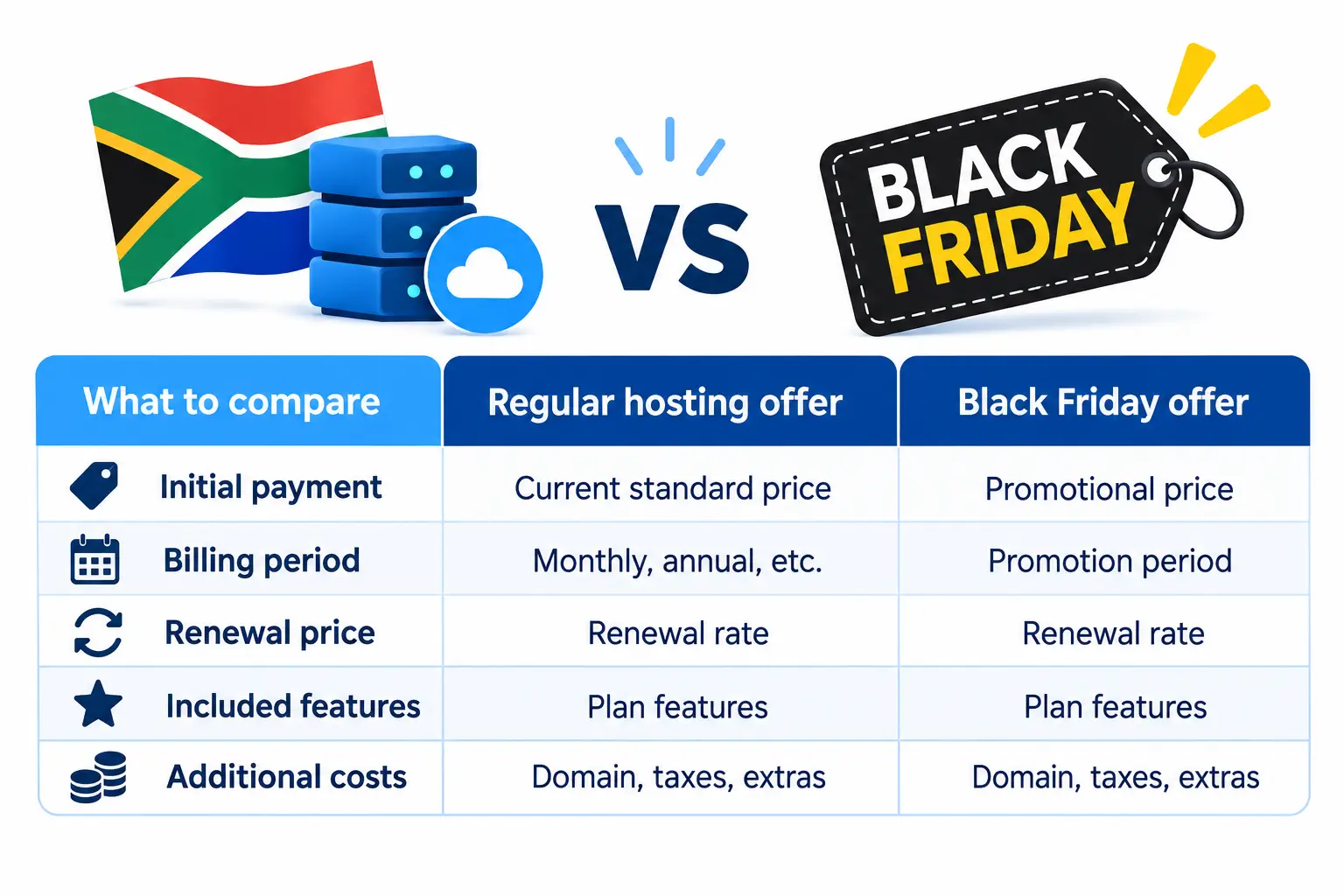
Use a table like the one below to line up the regular offer and the Black Friday offer.
Fill in the figures only after you have checked the provider’s current prices and confirmed the Black Friday promotion.
| What to compare | Regular hosting offer | Black Friday offer |
| Initial payment | Current standard price | Confirmed promotional price |
| Billing period | Monthly, annual, or longer term | Period required by the promotion |
| Renewal price | Published renewal rate | Renewal rate after the discount |
| Included features | Features in the selected plan | Features included in the discounted plan |
| Additional costs | Domain, taxes, or paid extras where applicable | Same costs checked against the promotion terms |
Here is what each row tells you.
- Initial payment. This is the amount charged at checkout. It is the number most banners shout about, but it is only the start of the story.
- Billing period. Hosting can be billed monthly, annually, or over two or three years. Promotions often need a longer period. Longer terms usually bring a lower monthly rate, and they also tie up more of your money.
- Renewal price. This is what you pay when the term ends. It is the row people skip, and it is often where a good-looking deal falls apart.
- Included features. Storage, email accounts, SSL, backups and support all affect the real cost. If a discounted plan leaves out something you need, you will end up paying for it separately.
- Additional costs. Domains, taxes and paid extras can add a surprising amount. A plan that looks R200 cheaper can lose that advantage once a domain and VAT are added.
The prices in each column must cover the same hosting tier and the same billing duration.
If you compare a 12 month regular price with a 36 month promotional price, the numbers will mislead you.
If the regular offer is a basic plan and the sale plan is a higher tier, you are not comparing like with like.
Be careful about where the numbers come from. Do not treat estimated or historical discounts as current Black Friday offers.
A deal that ran last year tells you what a provider has done before, not what it will do this year.
Only a published, confirmed promotion belongs in the Black Friday column.
A few extra notes can save you from surprises:
- Check whether the displayed price includes VAT. South Africa’s standard VAT rate is 15%, and a price shown without it will rise at checkout.
- If the price is shown in another currency, convert it and remember that exchange rates can shift before you pay.
- Look at what happens to the price after the promotional term ends.
- Write down the figures and the date you checked them, because offers change.
How to Calculate Your Real Black Friday Hosting Savings
You do not need to be good at maths to work out your savings.
You need the right numbers and a clear order. Follow these steps before you check out.
- Find the normal price and the promotional price for the same plan. Use the provider’s own pages. Make sure you are looking at the same hosting type and the same tier.
- Make sure both prices cover the same billing period. If one is monthly and one is annual, convert them so both show the cost over the same stretch of time.
- Calculate the difference between the two payments. Subtract the promotional total from the regular total.
- Add any applicable extras to each total. Include domain costs, setup fees, taxes and paid add-ons. Do this for both options.
- Check what the plan will cost when it renews. Add the renewal cost to your comparison for the period you plan to stay.
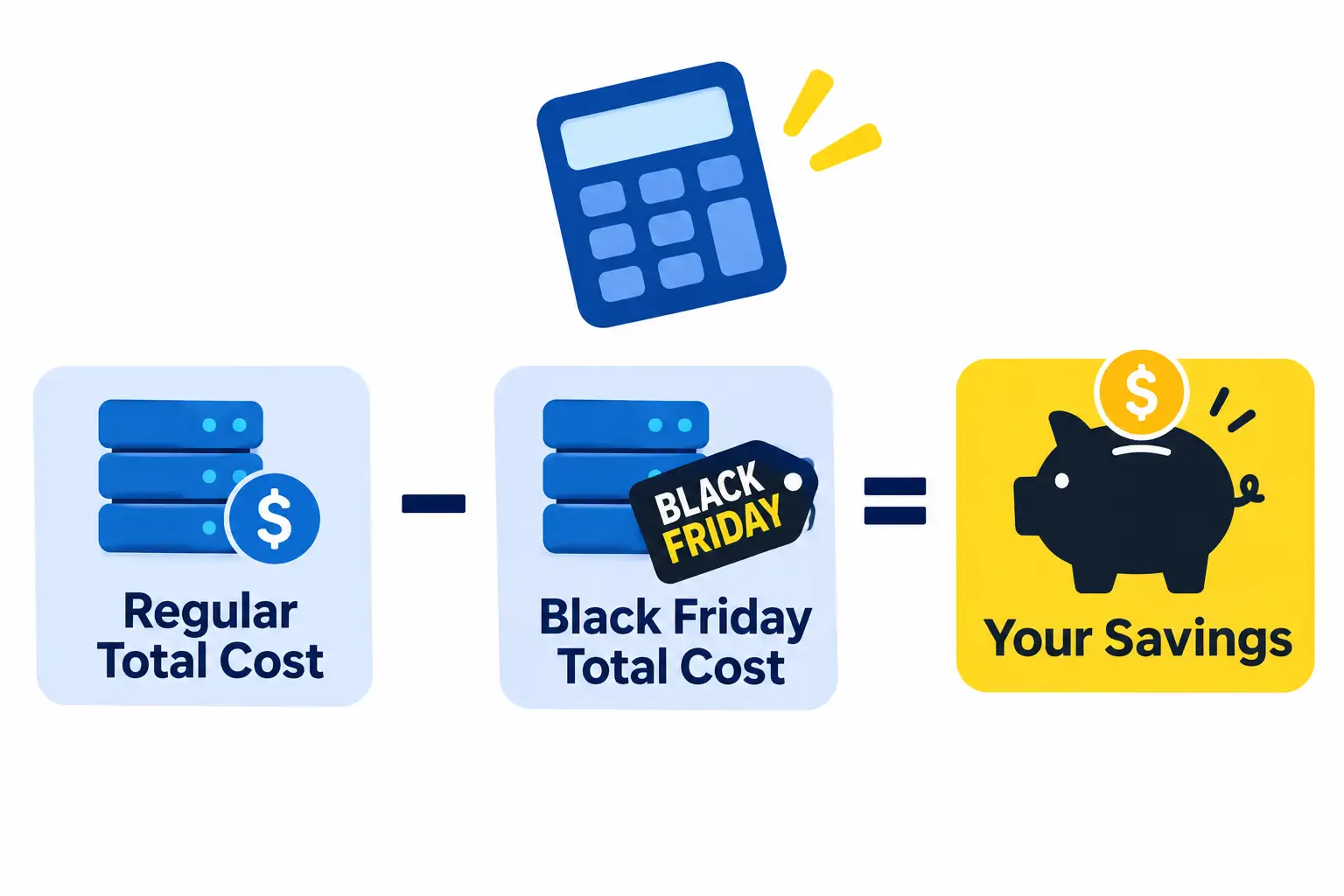
Here is the calculation in one line:
Savings = Regular total cost – Black Friday total cost
Now a clearly labelled hypothetical example. These figures are invented to show the method. They are not a real offer from any provider.
Suppose an equivalent hosting term normally costs R1,200. A verified promotion reduces it to R900.
The saving is R1,200 – R900 = R300. As a percentage, that is R300 divided by R1,200, which is 25%.
That comparison is valid only if both prices cover the same term and the same features.
If the R900 plan has less storage, no backups or a shorter term, the real saving is smaller than R300.
If the R900 plan includes a free domain that you would otherwise pay R200 for, the real saving may be larger.
Now extend the example to see why renewals count. Suppose the regular plan renews at R1,200 a year.
The promotional plan costs R900 for the first year, then renews at R1,600. Over two years, you pay R1,200 + R1,200 = R2,400 on the regular plan.
On the promotional plan you pay R900 + R1,600 = R2,500.
The sale saved R300 in year one and cost R400 extra in year two. Over the full period, the promotion is R100 more expensive.
The lesson is simple. A discount on the first payment is not the same as a lower total.
If you plan to stay for several years, include the renewal in the calculation. Then decide.
Budget also plays a part. A big multi-year payment can be a good saving on paper, but it needs cash upfront.
If paying R2,000 or more at once would strain your finances, a shorter term at a slightly higher monthly price may be the wiser choice.
A saving you cannot comfortably afford is not much of a saving. Think about your cash flow as well as the percentage off.
Here is a second hypothetical example, this time comparing different billing terms. Suppose a provider lists a plan at R120 a month on a monthly term.
Its annual price is R1,200, which works out to R100 a month. A Black Friday offer for a 24 month term is R2,160 upfront, which works out to R90 a month.
If you plan to keep the site for two years, the 24 month deal costs R2,160 against R2,400 on the regular annual route.
That is a saving of R240, or 10%.
If you only need the site for one year, the long term is no use to you, since you would pay for months you will not use.
The lowest price is not always the best choice for your plans.
Again, these numbers are invented to show the method. Replace them with real, verified prices before you decide anything.
One more step helps: divide each total by the number of months to get an effective monthly price.
It gives you a clean number to compare across providers and plans.
How to Find a Hosting Deal That Offers Real Value in South Africa
Good value comes from checking the details, not from chasing the biggest banner. Here is a practical way to find it.
- Check the hosting provider’s official website for published promotions and terms. The provider’s own pages are the most reliable source. Look for a dedicated Black Friday page, and read the conditions at the bottom. Third-party lists can point you in a direction, but always confirm on the provider’s site.
- Compare the actual checkout total rather than relying solely on the headline discount. Add the plan to the cart and see what you are asked to pay in rand. Look for VAT, setup fees and any extras that were added automatically.
- Review the renewal rate and required billing period. Find out how long you must commit and what the plan costs afterwards. A low first-term price that needs three years upfront may not suit your budget, and a high renewal rate can erase the saving.
- Confirm the plan’s features, support, backups, SSL and domain conditions. Check the storage, the number of email accounts, the resource limits, and whether backups are automatic. Ask how support works and when it is available. Look at whether SSL is free, and whether a free domain is included for the first year only or for the whole term.
- Keep a record of the regular and promotional prices so you can compare them accurately. Save screenshots or notes, with the date. Promotions change, and a record helps you spot whether a price has moved. It also gives you something to refer to if the final invoice looks different from what you expected.
Truehost is one option to consider when you compare. Its hosting page lists shared hosting plans and their billing options.
Verify the current prices and terms on the page before you purchase, because promotions and plan details can change.
Take your time with the numbers. A few minutes of careful checking can save you far more than any last minute rush at the countdown.
Visit Truehost to compare hosting plans and billing options, then check the published terms to decide whether a Black Friday offer gives you better value.