 Web Hosting
 Windows HostingBuilt for Windows apps and websites – stability, speed and flexibility
 Reseller HostingLaunch a hosting business without technical skills or expensive infrastructure
 Affiliate ProgramRefer customers and earn commissions from sales across our platform
 Domain SearchFind and secure a domain name in seconds with our quick lookup tool
 CO ZA Domains
 All DomainsExplore domain names from over 324 TLDs globally – all in one place
 Free Whois Lookup Tool South Africa
 VPS
VPS Website Builder
 Online ShopSet up a sleek eCommerce store with zero coding knowledge
 SSLs
SSLs SupportAccess help articles, how-tos, and everything about our services
 Blog
Blog Contact UsReach our team instantly via live chat or drop us an email
You got three quotes for a dedicated server. One says R1,400. Another says R6,000. A third landed at R12,000. The specs look similar on paper, so the gap makes no sense at first glance.
Pick the cheap one, and you might end up with a server that chokes under real traffic. Pick the expensive one, and you might be paying for hardware you will never use.
This guide breaks down what actually drives dedicated server pricing in South Africa, with real Rand figures, so you can look at any quote and know if it is fair.
Table of Contents
How Much Does a Dedicated Server Cost in South Africa Right Now

Dedicated server pricing in South Africa falls into three general bands. Entry-level plan on Truehost is available for R 1,170.00 a month.
These suit small business sites, internal tools, and low-traffic apps.
Truehost Mid-tier business plan goes for R 1,600.00 per month.
This range covers most growing eCommerce stores and busier web apps.
Truehost Enterprise configuration is available for R 2,160.00 a month. Heavy databases, large-scale platforms, and high-compliance workloads land here.
For readers comparing against international providers, that range converts to roughly $55 to $650 a month in US dollars. The exact figure moves with exchange rates, so treat it as a rough guide.
One thing to watch: a low sticker price does not always tell the full story. Some listings leave out setup fees or bandwidth costs. The next section shows exactly what pushes a quote up or down.
What Actually Drives Dedicated Server Pricing
Every quote comes down to five main factors. Once you know them, you can compare quotes properly instead of guessing.
1) CPU and Core Count
The processor is usually the single biggest line item on a quote. Intel Xeon chips tend to sit at the higher end, prized for stability under sustained load.
AMD EPYC and Ryzen options often cost less for similar core counts. More cores and threads mean a higher price, plain and simple.
A 4-core entry chip will always cost less than a 10-core enterprise one.
2) RAM and Storage Type
Storage type changes the price fast. HDD storage is the cheapest option but the slowest. SSD storage costs more and noticeably speeds up load times.
NVMe storage sits at the top of the price scale and delivers the fastest read and write speeds available.
RAID configurations, which mirror or stripe data across drives for safety, add further cost on top of the base storage price.
3) Bandwidth and Network Speed
Some plans cap monthly data transfer, while others offer unmetered bandwidth for a higher base price. Port speed also plays a role. A standard 1Gbps port suits most business sites.
A 10 Gbps unmetered port costs noticeably more and is well-suited to high-traffic platforms, streaming services, or gaming networks.
4) Managed vs Unmanaged Support
An unmanaged server hands you full root access and full responsibility. You patch it, monitor it, and fix it when something breaks.
A managed plan adds a support team that handles updates, monitoring, and backups on your behalf.
That convenience typically adds a real premium to the monthly price, often pushing a plan from one pricing band into the next.
5 Dedicated Server Providers in South Africa Reviewed
Real plan specs and prices tell you more than a general range ever will. Here is a closer look at five providers active in South Africa right now, starting with Truehost.
1. Truehost
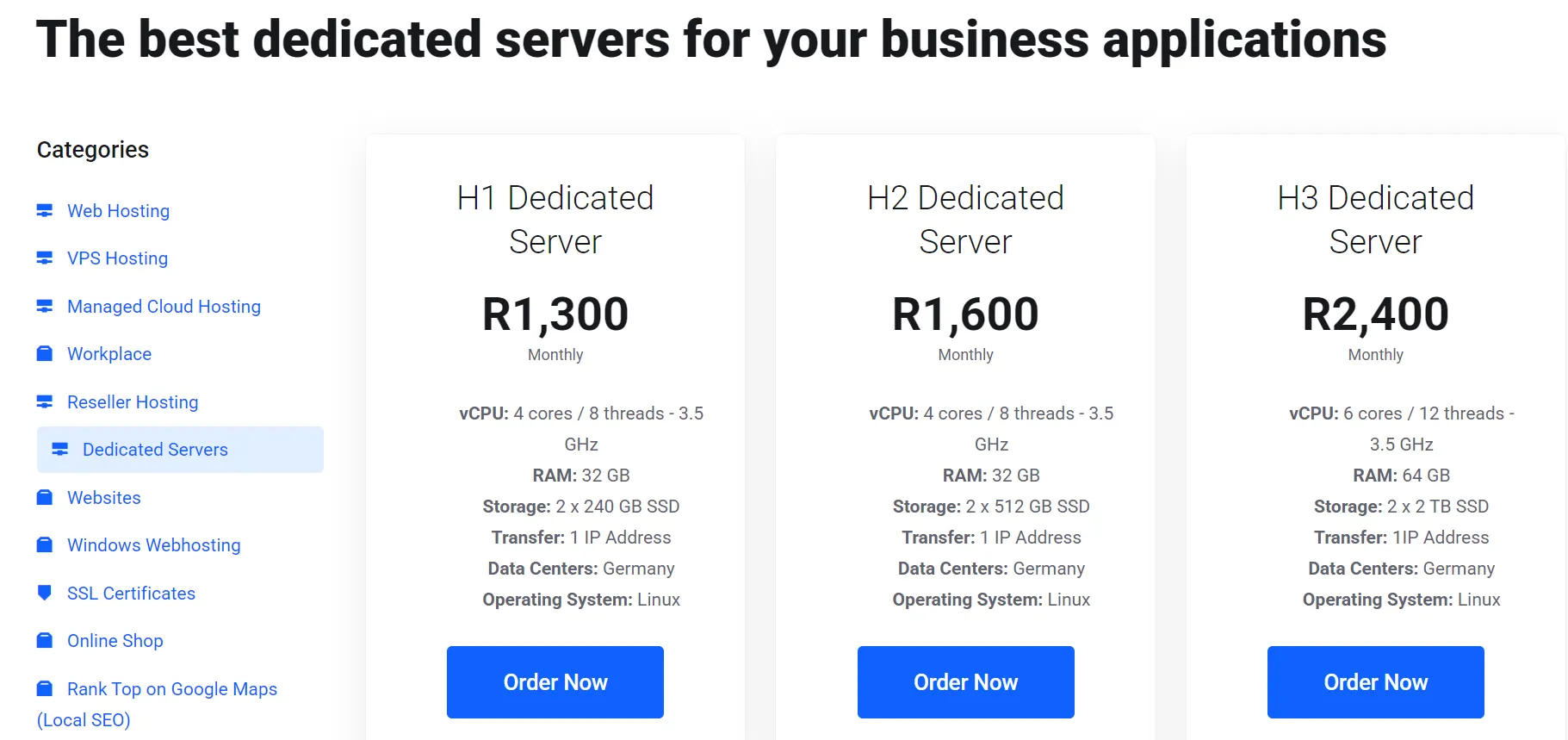
Truehost offers three main dedicated server plans in South Africa, each targeting a different stage of business growth. All three come with full root access, unlimited bandwidth, and Linux operating system choices.
| Plan | Price (Monthly) | CPU | RAM | Storage |
|---|---|---|---|---|
| H1 Dedicated Server | R 1,040.00 on triennial billing | Intel Xeon, 4 cores / 8 threads, 3.5 GHz | 32 GB | 2 x 240 GB SSD |
| H2 Dedicated Server | R 1,600.00 | Intel Xeon, 4 cores / 8 threads, 3.5 GHz | 32 GB | 2 x 512 GB SSD |
| H3 Dedicated Server | R 2,160.00 | Intel Xeon, 6 cores / 12 threads, 3.5 GHz | 64 GB | 2 x 2 TB SSD |
Every plan includes a dedicated IPv4 address, remote reboots, and a 99.9% uptime guarantee.
Longer billing terms bring the effective monthly price down noticeably, so businesses on a tight budget should compare triennial rates before deciding.
Truehost also offers optional managed support for teams that prefer not to handle patching and monitoring themselves.
2. Xneelo
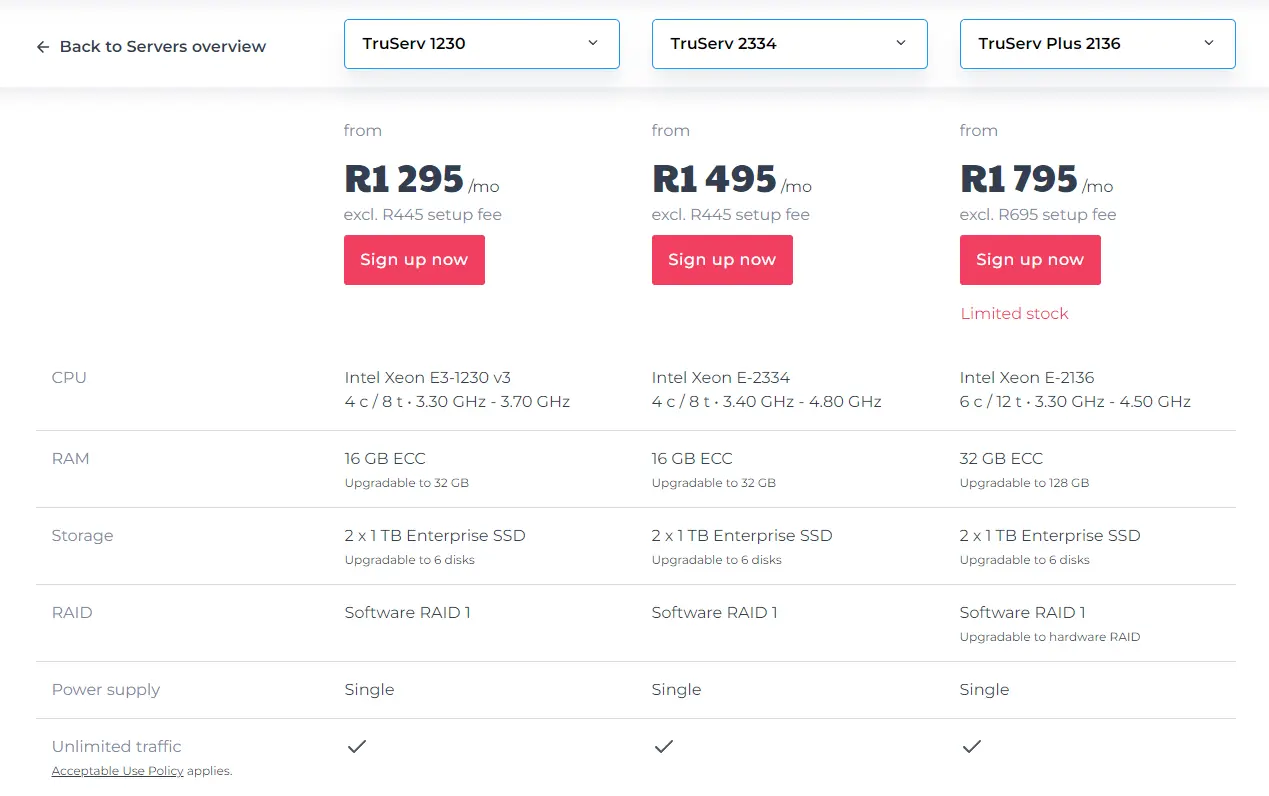
Xneelo, formerly known as Hetzner South Africa, splits its dedicated hosting into two tracks.
Self-Managed Servers start from around R1,295 a month and give you full root access with no hand-holding.
Managed Servers start at around R2,149 per month and include monitoring, backups, and DDoS protection, all handled by the Xneelo team.
Storage and networking come standard across the range, with a 1Gbps uplink and unlimited traffic included on self-managed plans. Higher-tier configurations scale RAM up to 256 GB.
3. Rackzar
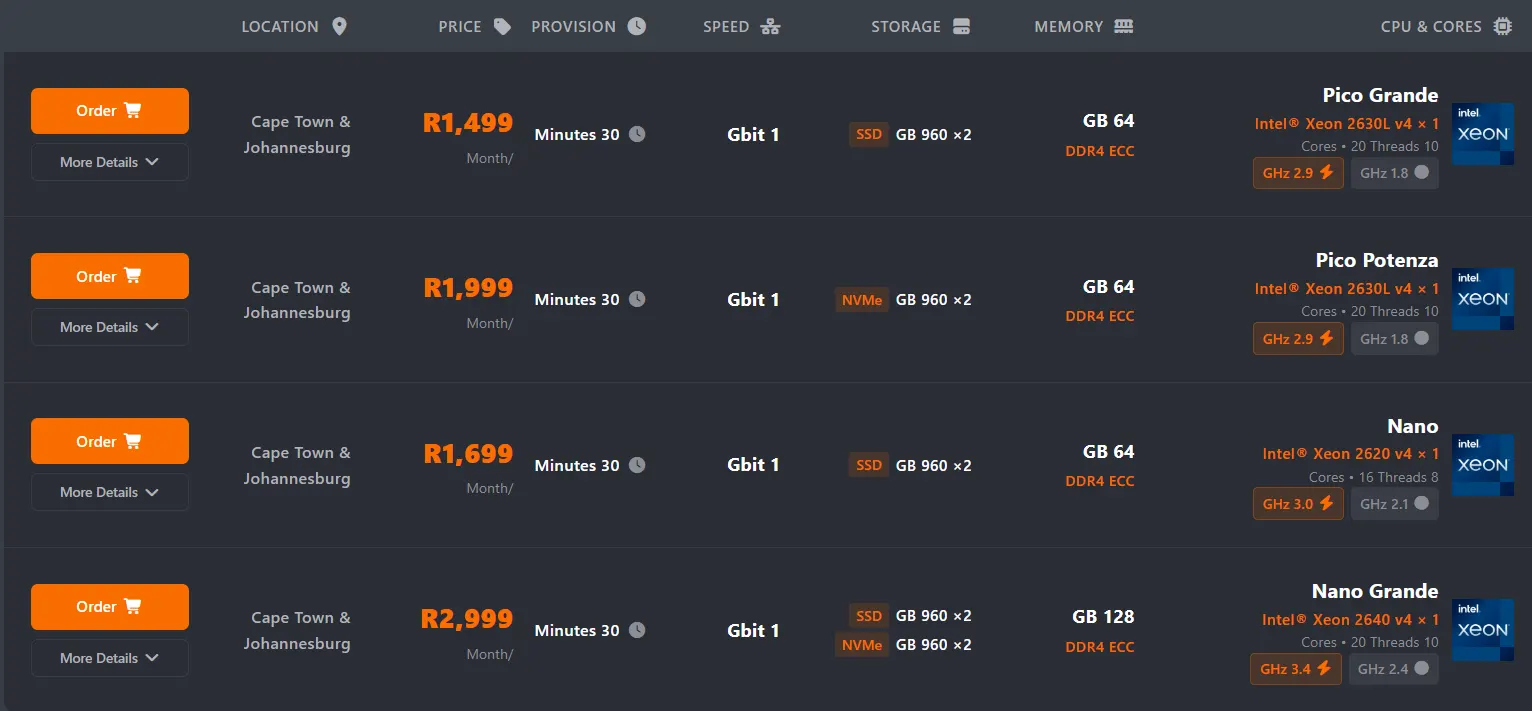
Rackzar positions itself as a South African-owned provider with data centers in Cape Town and Johannesburg.
Dedicated plans start at R1,499 per month and are built on AMD Ryzen or Intel Xeon processors with NVMe Gen4 storage.
Every server ships with full root access and 24/7 local support included. Rackzar also offers custom builds for businesses with specific CPU, RAM, or storage requirements outside the standard plans.
This flexibility suits companies that outgrow off-the-shelf configurations fast.
4. HostAfrica
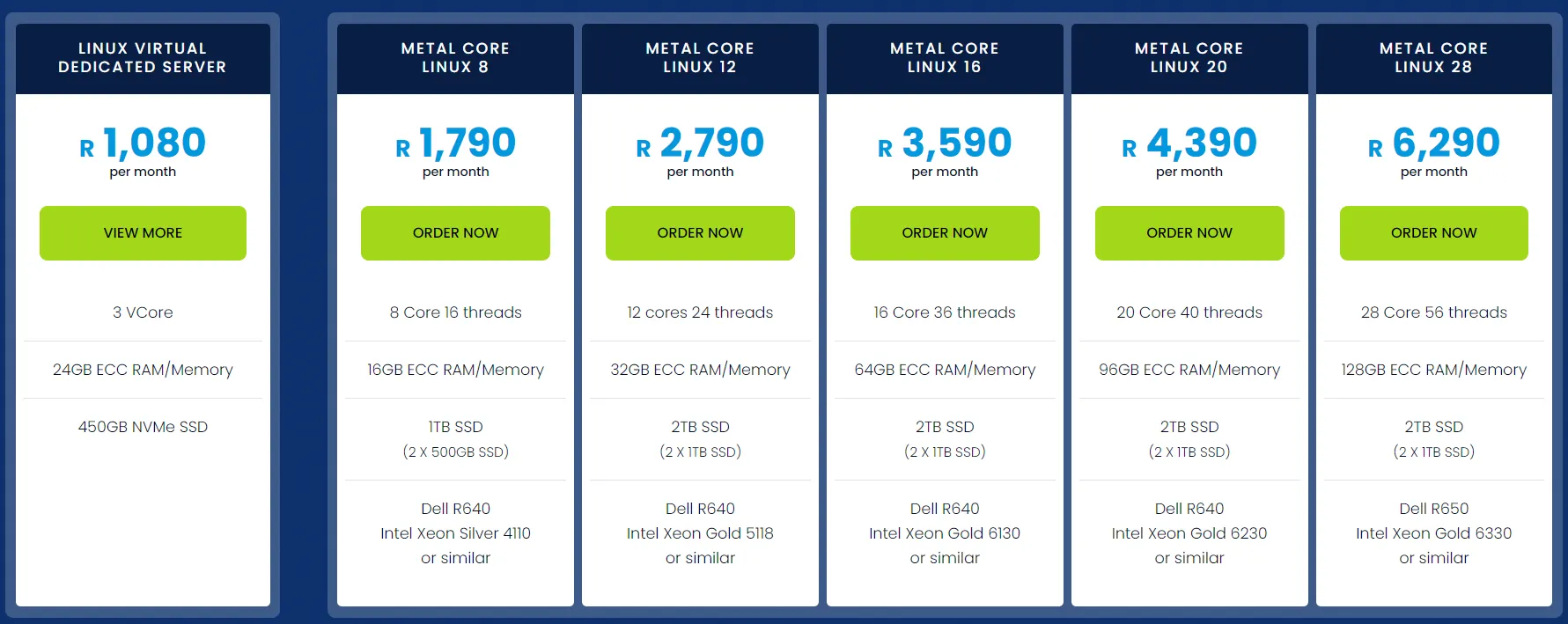
HostAfrica takes a quote-based approach to dedicated server pricing rather than listing fixed plans.
Entry-level configurations typically start at $80 to $120 per month, which converts to roughly R1,450 to R2,180, depending on the exchange rate.
Every dedicated plan includes dual power supplies, IPMI and remote management access, and a 1Gbit network port as standard.
An optional managed add-on brings proactive patching, backups, and monitoring for businesses that prefer a hands-off setup.
This provider suits buyers who want a configuration tailored to a specific workload rather than choosing from a fixed list.
Hidden Costs to Check Before You Sign
A few costs rarely show up in the headline price. Ask about each one before you commit to a provider.
- Setup or provisioning fees, charged once when the server first goes live
- Bandwidth overage billing is triggered once you pass your monthly data cap
- Extra IP address costs are needed if you run multiple sites or services on one box
- DDoS protection, sometimes bundled in, sometimes billed as a separate line item
- Windows Server or control panel licensing, added on top for non-Linux setups
Ask a provider to spell these out in writing before you sign anything. A quote that hides these costs will always end up more expensive than it first appeared.
Dedicated Server vs VPS Cost in South Africa
VPS hosting in South Africa typically costs between R500 and R2,500 per month. That undercuts most dedicated server plans by a wide margin. So why would anyone pay more?
A VPS still shares physical hardware with other tenants, even though your resources stay isolated. A dedicated server hands you the entire machine.
For steady, resource-heavy workloads running around the clock, a dedicated server often works out cheaper per unit of performance over time. For smaller or unpredictable traffic, a VPS remains the smarter spend.
Rule of thumb: start on a VPS. Move to a dedicated one once your traffic consistently stays high and a shared environment starts to limit performance.
Is a Dedicated Server Worth the Cost for Your Business
A dedicated server earns its price tag under specific conditions:
- Your site or app handles consistently high daily traffic
- You run a large database that needs guaranteed resources
- Your industry requires strict data isolation or compliance standards
- Downtime carries a real financial cost for your business
- You need custom hardware or specific configurations that a VPS cannot offer
A VPS or cloud plan still makes more sense in other cases:
- Your traffic is low, seasonal, or unpredictable
- You are testing a new product or an early-stage idea
- Your budget cannot yet support a managed support premium
Match the decision to your workload, not to what a competitor is running.
FAQs
Can I pay for a dedicated server in Rand, or is pricing usually in USD?
Most South African providers bill in Rand. Some international providers with local data centers bill in US dollars instead. Always confirm the billing currency before you sign, since exchange rate swings can change your effective monthly cost.
Is it cheaper to rent a dedicated server or buy and colocate hardware?
Renting almost always costs less upfront and avoids hardware maintenance headaches. Buying and colocating hardware can pay off over several years for large, stable operations with predictable long-term needs. For most small and mid-sized businesses, renting remains the cheaper and simpler route.
How much extra does DDoS protection typically add to the monthly price?
Basic DDoS protection is often included free with mid-tier and enterprise plans. Advanced protection, built for larger or repeated attacks, can add a noticeable premium to the base server price. Ask your provider exactly what level of protection is included by default.
Get Started With Dedicated Servers
Price alone never tells the full story on a dedicated server quote. Two servers at wildly different prices might suit two completely different workloads, and neither number is wrong on its own.
The real skill is matching specs, support level, and hidden fees to what your business actually needs.
Rather than guessing from a price table, get a quote matched to your specific workload. Talk to Truehost about your traffic, storage, and support needs.
We will set up a dedicated server plan priced around what your business actually costs to run, not a generic average.