 Web Hosting
 Windows HostingBuilt for Windows apps and websites – stability, speed and flexibility
 Reseller HostingLaunch a hosting business without technical skills or expensive infrastructure
 Affiliate ProgramRefer customers and earn commissions from sales across our platform
 Domain SearchFind and secure a domain name in seconds with our quick lookup tool
 CO ZA Domains
 All DomainsExplore domain names from over 324 TLDs globally – all in one place
 Free Whois Lookup Tool South Africa
 VPS
VPS Website Builder
 Online ShopSet up a sleek eCommerce store with zero coding knowledge
 SSLs
SSLs SupportAccess help articles, how-tos, and everything about our services
 Blog
Blog Contact UsReach our team instantly via live chat or drop us an email
Self-hosted AI agents went from niche to mainstream fast. Two names now dominate every forum thread: OpenClaw and Hermes Agent.
The multi-agent space has split into two camps. One side builds for modularity and broad reach, deploy fast, connect everything, and get moving.
The other builds for depth and long-term intelligence, an agent that gets smarter the longer it runs.
Here’s the verdict upfront: OpenClaw = breadth and speed. Hermes = depth and learning.
This article compares openclaw vs hermes agent on: how their architectures differ, how they handle memory and skills, where each one falls short on security, and which one makes sense for your setup.
Table of Contents
What Each Tool Is
OpenClaw
OpenClaw started as a personal project by Austrian developer Peter Steinberger.
First published in November 2025 under the name Warelay, it went through two forced renames before landing on OpenClaw on January 30, 2026.
What started as a weekend hack became one of the fastest-growing open-source AI agent frameworks in history.
The repo now sits at 38,000+ GitHub stars. NVIDIA built an enterprise fork called NemoClaw.
In February 2026, Steinberger joined OpenAI, and the project moved to an independent community foundation.
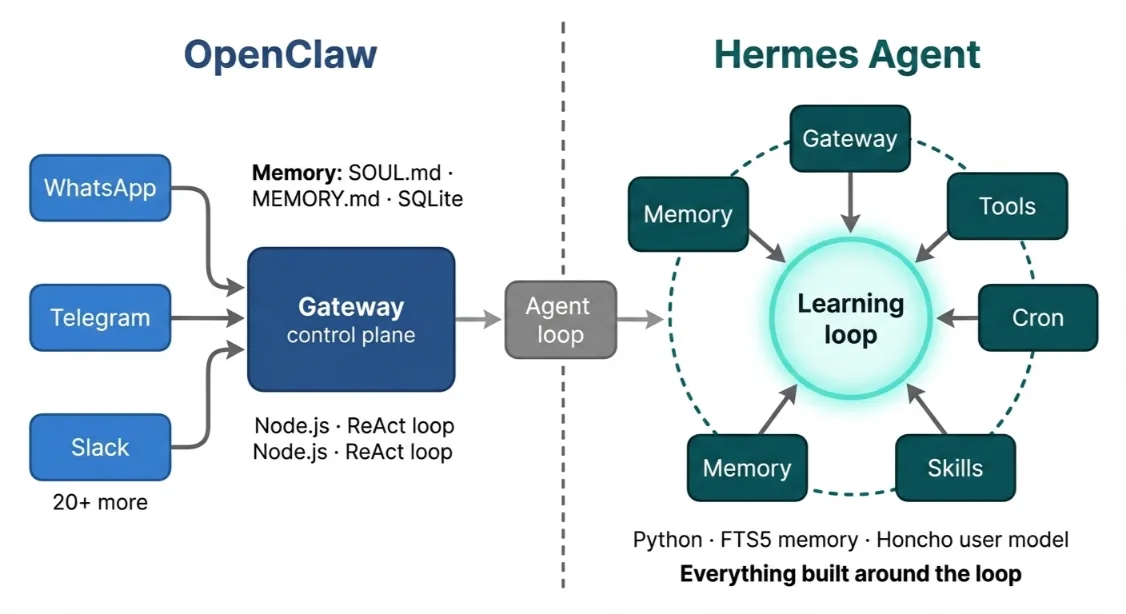
Core identity: A central Gateway that routes messages from 20+ chat apps into an agent runtime. Fast to set up, broad reach, massive ecosystem.
Hermes Agent
Hermes Agent was built by Nous Research, the lab behind the Hermes model family, and positions itself as an autonomous agent that gets smarter the longer it runs.
It launched on February 25, 2026, and accumulated over 180,000 GitHub stars in under four months, making it the fastest-growing open-source agent framework of 2026 by Dealroom’s count.
As of June 24, 2026, the core repo sits at 204,000+ stars. It is MIT licensed.
Core identity: The learning loop is the product. Everything else gateway, memory, tools, cron is built around it.
Read also: Top OpenClaw AI Assistant Capabilities
Architecture (The Design Differences)
Both tools share the same high-level pattern: a persistent process, messaging app connections, LLM calls, tool execution, and state management.
But the control plane is different.
OpenClaw uses the Gateway as its control plane. A single Node.js process owns everything sessions, routing, tools, and state. It uses a ReAct loop (reason → act → observe), with memory stored in plain Markdown files and SQLite.
Hermes flips this. The agent loop itself is the control plane. It creates skills from experience, improves them during use, searches its own past conversations for context, and builds a deepening model of who you are across sessions.
Gateway, cron, tooling, and memory are structured around the learning cycle, not the other way around.
That architectural choice is important.
According to Stanford HAI’s 2026 AI Index, AI agents went from 12% to roughly 66% task success on OSWorld, a benchmark that tests general computer use across operating systems, but they still fail about one out of every three structured tasks.
Hermes is architecturally designed to narrow that gap over time. OpenClaw is not.
The Learning Loop
This is the section that justifies the whole comparison.
Most agents are stateless. They execute tasks and retain nothing. Some bolt-on memory as a manual add-on.
Hermes makes the learning loop a first-class feature of the architecture itself.
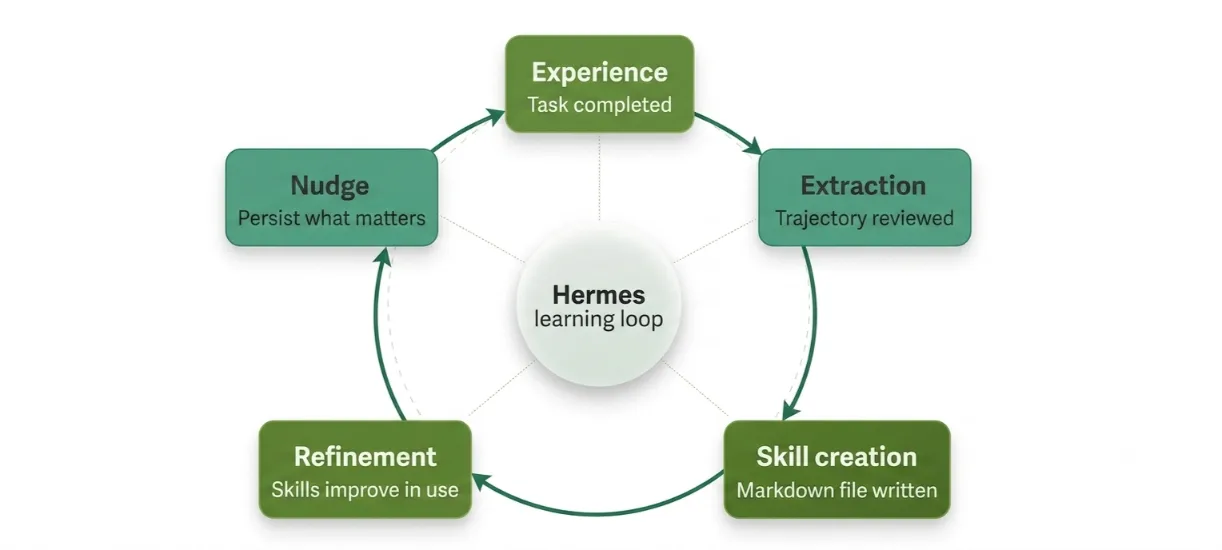
After a task finishes with five or more tool calls, a background process summarises the trajectory into a Markdown skill file with a YAML frontmatter header.
The skill is plain text on disk, you can read it, edit it, delete it, commit it to git.
The five-step cycle looks like this:
| Step | What Happens |
|---|---|
| Experience | Agent completes a multi-step task |
| Extraction | Background process reviews the trajectory |
| Skill Creation | Reusable Markdown skill file is written to disk |
| Refinement | Skills improve with each similar task |
| Nudge | Agent prompts itself to persist new learnings |
As of v0.12.0, an autonomous Curator grades, consolidates, and prunes the skill library on a 7-day cycle.
The agent doesn’t just learn, it maintains what it learns.
The practical implication is significant.
The performance claim is specific: agents with 20+ self-created skills complete similar future tasks 40% faster than fresh instances in token consumption and wall-clock time.
TokenMix’s independent benchmarks corroborated this figure in April 2026.
OpenClaw’s skills stay as written unless you manually update them. One model scales through internal learning. The other scales through community contribution.
Learn how to set up OpenClaw on a VPS
Memory Systems
OpenClaw uses SOUL.md, MEMORY.md, and USER.md are plain Markdown files, SQLite-searchable. Simple, editable, transparent. No automatic cross-session persistence without manual setup.
Hermes uses a layered memory stack:
- Persistent notes and session history with FTS5 full-text search
- User modeling via Honcho dialectic
- Procedural memory (skills) written autonomously
- Hot/cold architecture for token efficiency
There’s also a security layer baked in. Memory entries are scanned before being accepted into the system prompt.
Content matching threat patterns, prompt injections, credential exfiltration, SSH backdoor attempts, or invisible Unicode characters is blocked before it can reach the agent.
Main distinction: OpenClaw remembers what you tell it. Hermes learns from what it does.
Skills and Ecosystem
| Feature | OpenClaw | Hermes Agent |
|---|---|---|
| Marketplace | ClawHub: 5,700+ skills | agentskills.io (growing) |
| Skill format | Custom Markdown | Open standard (portable) |
| Skill creation | Manual only | Autonomous + manual |
| Skill improvement | You edit it | Self-improving during use |
| Built-in tools | Via plugins | 40+ bundled |
| MCP support | Yes | Yes + MCP Server Mode |
OpenClaw wins on ecosystem breadth: 5,700+ community skills, a ClawHub plugin marketplace, support for 24+ messaging platforms.
That’s a real advantage today. If you need to download a skill and keep moving, ClawHub delivers.
Hermes’s open standard is important for the longer term. Skills built on agentskills.io are portable across frameworks, not locked to one ecosystem.
If the skill registry matures with signing and curation, it becomes infrastructure.
Security
This is OpenClaw’s weakest area in 2026. Let’s be direct about it.
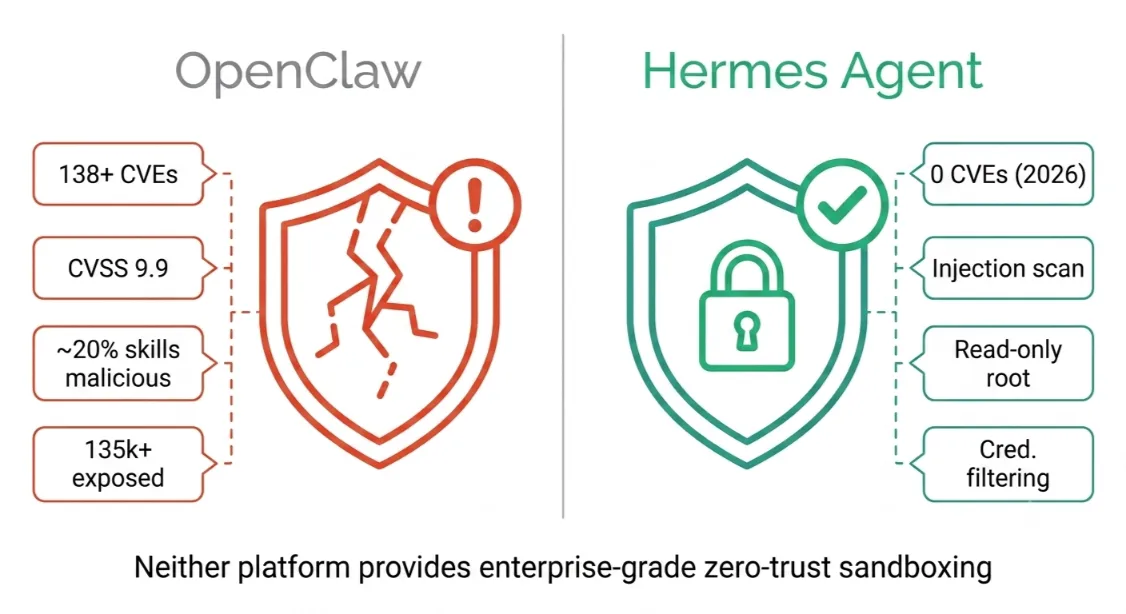
Two critical CVEs were disclosed at CVSS 9.9, CVE-2026-22172 and CVE-2026-32922, both enabling full administrative control without credentials. By April 3, 2026, over 1,400 malicious skills had been confirmed active on ClawHub.
Researchers confirmed 341 malicious skills out of 2,857 in ClawHub, approximately 12% of the entire registry.
Updated scans later reported more than 800 malicious skills, approaching 20% of the marketplace.
30,000+ internet-exposed instances were identified by multiple scanning teams. CVE-2026-25253, rated CVSS 8.8, was a one-click RCE chain exploitable even against localhost-bound instances.
The team has patched aggressively, CVE-2026-32922 received a patch 13 days after disclosure, but the pattern is important. Rapid growth created rapid attack surfaces.
Hermes has zero reported agent-specific CVEs as of June 2026. That partly reflects limited exposure compared to OpenClaw’s scale, not necessarily proven hardening. Still, the default posture is more cautious:
- Prompt injection scanning on memory entries
- Credential filtering before system prompt injection
- Container hardening with read-only root and dropped capabilities
- WhatsApp rejects strangers by default; Discord role-allowlists are guild-scoped
Honest caveat: neither platform provides enterprise-grade zero-trust sandboxing. Both are self-hosted tools that run with your credentials. Treat them accordingly.
Check out our guide on the 9 best VPS providers for OpenClaw
Deployment and Cost
Both tools are free under MIT. Your costs are infrastructure and LLM API usage.
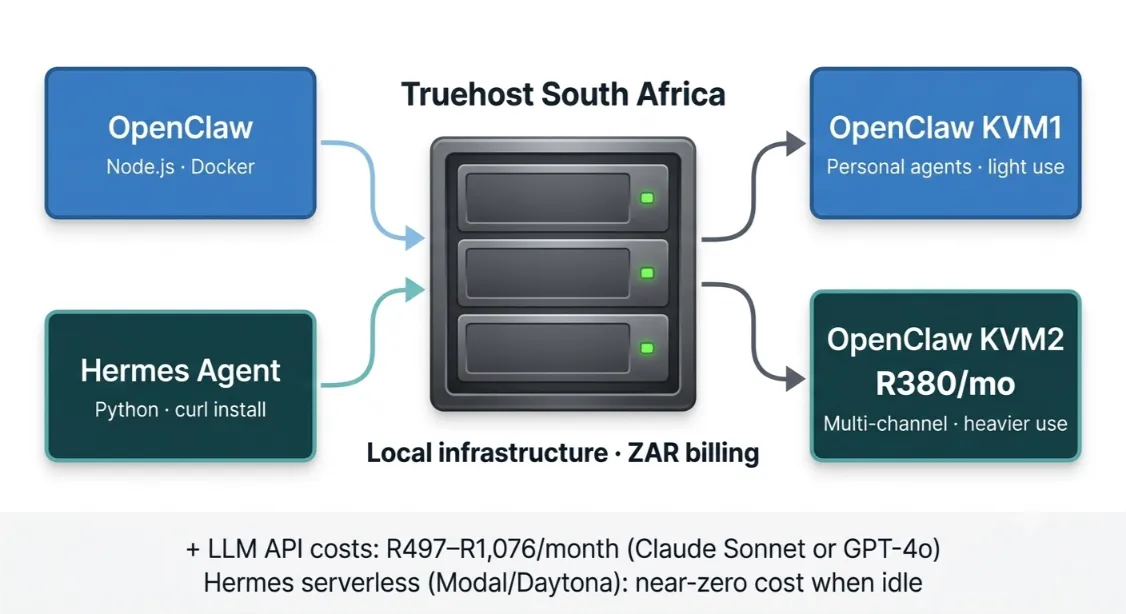
OpenClaw runs on Node.js. You can deploy it on a VPS or via Docker.
At Truehost, we offer OpenClaw-ready VPS hosting in South Africa specifically tuned for this workload:
- OpenClaw KVM1 R285/month, suited to personal agents and light automations
- OpenClaw KVM2 R380/month, better for multi-channel setups with heavier tool use
Hermes is Python-based. It runs across six terminal backends: local, Docker, SSH, Daytona, Singularity, and Modal. Daytona and Modal offer serverless persistence; your environment hibernates when idle, costing nearly nothing.
Installation is a single curl command. No prerequisites; it installs everything automatically.
For LLM API costs, budget R497–R1,076/month (~$30–$65) with Claude Sonnet or GPT-4o for moderate workloads.
Serverless deployment on Modal or Daytona can bring that down significantly if your agent is mostly idle.
If you want a managed environment that handles the infrastructure so you can focus on the agent, our OpenClaw hosting plans cover both tools.
When to Choose Each
Choose OpenClaw if:
- You need something running in under an hour
- Your workflows are stable and well-defined
- You want immediate access to 5,700+ community skills
- You need 20+ messaging channels from one gateway
- Your team knows TypeScript/Node.js
Choose Hermes Agent if:
- You want an agent that improves without manual intervention
- You need serverless deployment for cost efficiency
- Security-by-default is important more than ecosystem size
- You’re building something long-term, not a quick automation
- You value deep personalisation over broad optionality
Whichever direction you choose, the infrastructure decision is the same: you need a reliable VPS that stays online, handles the persistent process cleanly, and doesn’t go down mid-task.
We at Truehost have hosting plans built specifically for OpenClaw in South Africa with local data residency, ZAR billing, and support that understands the workload.
OpenClaw vs Hermes Agent FAQs
Is Hermes Agent free to use?
Yes. Hermes Agent is MIT licensed, free to use, modify, and build on. Your costs are the VPS and LLM API calls. No licensing fees.
Can I migrate from OpenClaw to Hermes?
Yes. Hermes includes a built-in migration path. The setup wizard automatically detects your ~/.openclaw directory and offers to import your settings, memories, skills, and API keys before configuration begins. You can also run hermes claw migrate --dry-run to preview what would transfer.
Which AI models do they support?
Both support Claude, OpenAI’s GPT models, and DeepSeek. Hermes works with Nous Portal, OpenRouter (200+ models), NovitaAI, NVIDIA NIM, Hugging Face, and any custom endpoint. OpenClaw connects to most frontier models via API key configuration.
Can you run both on the same VPS?
You can, though it’s not recommended for small instances. Both run persistent processes with memory, sessions, and gateway connections. A KVM2 plan or higher gives you enough headroom to run both without interference.
Which is better for a small business in South Africa?
For most small businesses in South Africa, OpenClaw is the faster starting point, the skill library is larger, setup is quicker, and the community documentation is more mature. Hermes makes more sense if you’re planning to run the agent continuously over months and want it to learn your workflows over time. Both run cleanly on our South African VPS plans with ZAR billing and local infrastructure.
What’s the best LLM to run with Hermes Agent?
Claude Sonnet 4.5 and GPT-4o are the most commonly recommended for balanced performance and cost. If you want to keep costs very low, OpenRouter gives you access to 200+ models including strong open-weight options like Qwen and Llama. Switch models any time with hermes model No code changes required.