 Web Hosting
 Windows HostingBuilt for Windows apps and websites – stability, speed and flexibility
 Reseller HostingLaunch a hosting business without technical skills or expensive infrastructure
 Affiliate ProgramRefer customers and earn commissions from sales across our platform
 Domain SearchFind and secure a domain name in seconds with our quick lookup tool
 CO ZA Domains
 All DomainsExplore domain names from over 324 TLDs globally – all in one place
 Free Whois Lookup Tool South Africa
 VPS
VPS Website Builder
 Online ShopSet up a sleek eCommerce store with zero coding knowledge
 SSLs
SSLs SupportAccess help articles, how-tos, and everything about our services
 Blog
Blog Contact UsReach our team instantly via live chat or drop us an email
South Africa has a small business problem. For anyone exploring reseller hosting in South Africa, that problem is actually an open door.
Reselling web hosting services often sounds too technical, while in reality, it’s the least technical solution for supplying hosting needs to local small businesses.
There are over 2 million small and medium enterprises operating in ZA right now. A vast majority of them don’t have a website or a professional email.
This creates an untapped demand for web hosting that the large multinational web hosting companies often underserve.

By the end of this guide, you will have a clear, actionable plan to launch your own hosting agency in South Africa, from choosing a hosting provider such as Truehost to signing your first client.
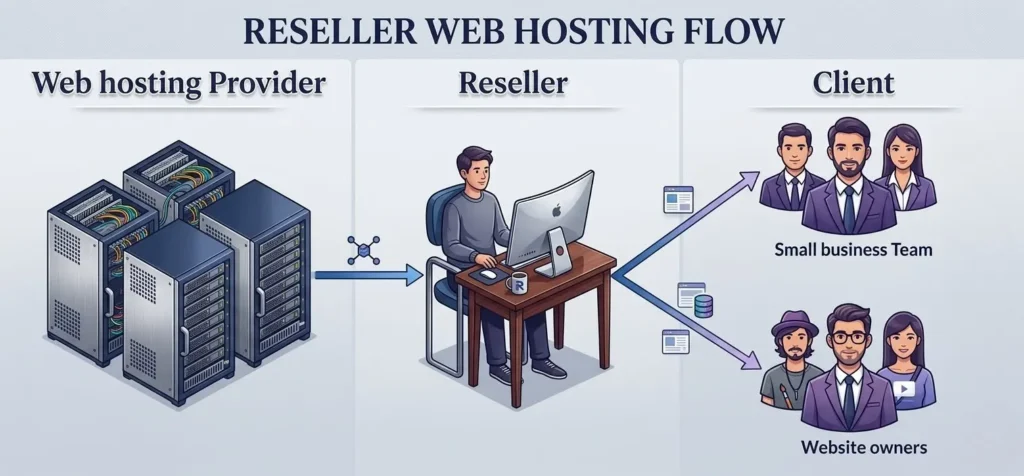
Table of Contents
What is Reseller Hosting?
Reseller hosting is pretty straightforward once you wrap your head around it. You buy a chunk of web hosting resources from a bigger provider like Truehost, then turn around and rent that space to your own clients under your brand.
You never touch a single server, yet you’re running a hosting business.
Think of your reseller hosting provider as your wholesaler. You’re buying server resources in bulk at a discounted rate, the same way a retailer stocks up on inventory before selling it at a markup.
Your clients are on the other end of that chain. They pay your price, they see your brand, and they have zero idea who your supplier is. That gap between what you pay and what they pay? That’s your profit.
The beauty of it is the split in responsibility. Someone else worries about the infrastructure. You focus on the customer relationships.
How Reseller Hosting in South Africa Works In Practice
Once you sign up for a reseller hosting plan, you sit between two parties: the parent host and your customers. Your clients never interact with your parent host.
They log into your branded control panel, pay your invoices, and contact your support team. From their perspective, you are the hosting company.
Truehost lets you remove any mention of the parent host and replace it with your agency name, logo, and colours.
You can set up custom nameservers, such as ns1.youragency.co.za, so even the technical details point back to your brand. A client doing a nameserver lookup won’t see your supplier’s name anywhere.
Why South Africa Is Ripe For Reseller Hosting
South Africa has one of the highest internet penetration rates on the African continent, with more than 51 million daily internet users.
The digital boom is real, and in ZA it’s only accelerating, creating thousands of small businesses and digital entrepreneurs who all need a website, a work email address, and somewhere to host it all.
At the enterprise level, there are already well-established ZA hosting companies. Still, they don’t offer the personalized, small-business-focused, and niche-agency-level support, which sets the market up perfectly for reseller hosting in South African agencies.
A reseller who focuses on, say, Cape Town restaurants, or Gauteng accounting firms, or township-based entrepreneurs, is operating in a space where almost nobody else is showing up with a tailored offering.
Niche resellers who serve a specific community well tend to grow almost entirely through word of mouth.
The Reseller Hosting in South Africa Business Roadmap
Starting a hosting agency in South Africa is one of the more accessible tech businesses you can build. The low startup costs, recurring revenue, and a growing local market make it genuinely attractive.
Like any business, the difference between agencies that thrive and ones that quietly fold comes down to how well they planned from the start. This roadmap walks you through every step.

Step 1: Define Your Niche and Target Market
The biggest mistake new resellers make is trying to sell to everyone. “Anyone who needs hosting” is not a target market; it’s a recipe for blending into the noise.
Pick a lane and stick to it. Think about the communities or industries you already have access to, credibility in, or a genuine interest in serving. Some examples that work well in the South African context:
- Small retail businesses in your city need a simple website and email hosting.
- Professional practices, such as legal and accounting, require reliable hosting with high uptime.
- Local entrepreneurs and informal sector businesses are coming online for the first time.
- Local organizations such as churches, NPOs, and schools are looking for affordable, locally supported web hosting.
- SaaS companies that are looking to provide bundled hosting for their web apps.
Once you know who you’re serving, everything else, from your pricing, your branding, your support style, to even the features you lead with, becomes much easier to decide.
Your niche doesn’t have to be permanent. Most successful hosting agencies started narrow and expanded once they had a stable client base and a strong reputation in one area.
Step 2: Choose The Right Reseller Hosting in South Africa Service Provider
Your parent host is the foundation on which your entire business sits. Truehost offers great uptime, fast support, and reliable infrastructure, ensuring that your clients’ websites are up and running at all times.
Truehost offers white-label hosting with private nameservers, meaning you can use your own branding and have full access to configure and manage individual cPanel accounts on your network.
With the free SSL certificates, you can secure every client site at no extra cost.
Why Truehost?
- Unlimited bandwidth
- Private nameserves
- Softaculus Auto script installer
- Unlimited MySQL databases
- JetBackup, Immunify, and Softaculous
- Instant setup
- 24/7- 365 customer support
- Real-time client usage stats
- Free SSL certificates
Step 3: Set up Your Hosting Infrastructure
- Sign Up
Head over to https://truehost.co.za/hosting/reseller/ and select a plan that best fits your business plan. The Bronze package starts at R137.5 and includes 20 cPanel accounts.
After selecting a plan, you can choose to register a new domain, transfer your domain from another registrar, or use your existing domain and update your nameservers.
Truehost is currently offering a free co.za domain registration. Hurry up and grab the deal before the promotion expires.
- Access your dashboard
After completing the setup guide, you can use your credentials to access your dashboard. Truehost Reseller plans include full access to Web Host Manager (WHM).
With WHM, you can create cPanel accounts, monitor client resource usage, set disk space and bandwidth quotas for individual cPanel accounts, and brand the client experience.
- Create accounts
Use your WHM dashboard to create and delete accounts as needed. You can also use it to suspend and reactivate accounts if need be.
You should also consider getting the Web Host Manager Complete Solution (WHMCS), which offers billing and automation tools for invoicing clients, creating accounts, and sending branded emails.
- Do a test run
To test the setup, use WHM to create a sample client account and Softaculous for one-click WordPress installs. You can customize the sample website to serve as the hosting agency’s portfolio that you can show to potential clients down the line.
In case you get lost, don’t hesitate to get in touch with the Truehost live chat team, and they will guide you through the entire process and resolve any issues that might arise.
Step 4: Build Your Brand And Online Presence
You are asking potential clients to trust you with the digital front door of their business when you host their website, so your own online presence needs to reflect that you take this seriously.
Make sure your agency website has a clean homepage that clearly explains the services you offer, and a hosting plans page with transparent pricing in Rands.
You should also have a contact page with a real email address and, ideally, a WhatsApp Business number so clients can easily get in touch with you.
The agency will also need a client portal, which you can add once you have the billing system in place.
Brand everything from your professional logo to consistent colour schemes and tone of voice in your website’s pages.
Remember, clients will only see your branding, not the hosting company’s, so it’s your job to build legitimate branding and authority.
Remember to address local visibility needs by setting up a Google Business Profile, which will appear in local search results.
While at it, set up social media accounts for the agency, such as a Facebook Business page, a LinkedIn profile, X, and a WhatsApp Business Account.
You do not need a massive marketing budget to look credible. You need consistency and attention to detail. A simple, well-written website beats a flashy one with vague copy every single time.

Step 5: Structure Your Pricing and Hosting Plans
Pricing is where most new resellers either undersell themselves into thin margins or overprice themselves out of the market. Neither extreme works.
Start with your costs. Know exactly what your parent host charges you per client account or per GB of storage. That is your floor, hence you cannot price below it.
Build in your overhead. Your time has value. So does your billing software, your domain, your website, and the support hours you will spend helping clients.
Factor all of that in and use the common approach of setting a 40% markup on cost and adjusting it as needed.
Create two or three plan tiers. A simple structure works best:
- Starter: ideal for personal sites, bloggers, or very small businesses. Basic storage, limited email accounts, and one domain.
- Business: the plan most clients will choose. More storage, more email accounts, free SSL, and daily backups.
- Pro: for growing businesses or light e-commerce. Maximum resources, priority support, and additional domains.
Step 6: Handle Billing, Legal, and Compliance Requirements
This is the step most people want to skip. Do not skip it. Getting the business foundations right protects you, builds client trust, and keeps SARS and other governing bodies happy. Follow these steps:
- Register your business
Registering your reseller hosting business in South Africa, even a simple sole proprietorship, is a start, but registering a private company (Ltd) through CIPC gives you more credibility and better legal protection. It costs a few hundred rand and is worth every cent down the line.
- Ensure tax compliance
To sort out your tax compliance register with SARS for income tax. Once your turnover crosses R1 million annually, you are required to register for VAT, but many hosting agencies choose to register earlier for the credibility it adds when invoicing business clients.
- Comply with POPIA
The Protection of Personal Information Act is not optional. You are storing client data, website files, email content, and personal details.
Your privacy policy, terms of service, and data-handling practices must reflect your obligations under POPIA. If you are unsure, a single consultation with a local attorney is a worthwhile investment.
- Write your Terms of Service and Acceptable Use Policy
Your Terms of Service and Acceptable Use Policy documents protect you when a client misuses their hosting account, disputes an invoice, or demands a refund you are not obligated to give.
Template versions are available online, but have them reviewed for the South African legal context before you publish them.
4. Set up your billing system
WHMCS is the industry standard; it handles automated invoicing, payment reminders, account provisioning, and client management in a single platform. Connect it to a South African payment gateway like PayFast or Peach Payments so clients can pay in rands by card or EFT without friction.
Step 7: Launch, Market, and Grow Your Client Base
Everything up to this point has been preparation. It is time to build an empire.
Start with your warm network. Your first clients will almost certainly come from people who already know you: friends, family, former colleagues, business contacts.
Reach out personally. Offer them a genuine deal in exchange for honest feedback and a testimonial. Five real clients with five real reviews are worth more than any marketing campaign you could run in month one.
When it comes to marketing, local SEO is one of the highest-return activities for a hosting agency. Make sure your website is optimised for terms like “web hosting [your city]” and “reseller hosting in South Africa.”
Publish useful content that answers the questions your target clients are already asking, things like “how much does website hosting cost in South Africa” or “what is the best hosting for small businesses in SA.”
While at it, remember to build a referral programme early. Web designers and developers are natural partners for a hosting reseller. They build sites; their clients need somewhere to host them.
A simple referral fee or revenue share arrangement can become one of your most consistent sources of new clients. Approach a few local web designers directly and propose a simple idea.
Common Mistakes To Avoid

- Neglecting WhatsApp Business
In the South African market, WhatsApp is often the preferred communication channel for small business owners.
Having a dedicated WhatsApp Business number for your reseller hosting agency in South Africa, with automated welcome messages and quick replies, makes you more accessible than most big hosting companies your clients have dealt with before.
- Treating support as an afterthought
Your clients chose you over a faceless international provider because they expected a better experience.
If your response times are slow, your communication is vague, or you go quiet when there is a problem, you have destroyed the main reason they signed up with you in the first place.
Support is not a cost centre in a reseller business, as it is your primary product differentiator. Treat it that way from day one.
- Ignoring upsell opportunities
Hosting alone is a relatively low-ticket product. The real margin in a reseller business comes from selling adjacent services that your clients genuinely need anyway:
- Automated daily backups
- Professional email hosting
- Domain registrations
- Website maintenance plans
- Security scanning.
A client paying R150 a month for basic hosting could reasonably be paying R400 to R600 a month once you bundle in the services they would have bought elsewhere. Do not leave that revenue on the table out of timidity.
- Not monitoring your clients’ uptime proactively.
Waiting for a client to tell you their site is down is the wrong approach. By the time they notice and contact you, the site may have been offline for hours.
Set up free uptime monitoring tools like UptimeRobot for every client domain from the moment you provision their account.
If something goes down, you want to know about it first and ideally have an update ready before your client even notices.
- Underpricing your plans
New resellers often price low out of fear that no one will pay more or that they will lose a deal to a bigger competitor. The result is a business with thin margins that punishes you every time a client needs support.
It’s recommended to price based on the value you deliver, not on what the cheapest option on the internet charges. You are offering local service, personal support, and ZAR billing. That is worth a reasonable premium.
Conclusion: Launch Your Reseller Hosting in South Africa Today
Starting a reseller hosting agency in South Africa is not a pipe dream; it’s a real, buildable business with low startup costs.
From picking a niche and owning it, to selecting the right parent host and building a brand clients trust, you now have everything you need to launch.
The local market is underserved, the recurring revenue model is proven, and the roadmap is in your hands.
All that is left is to start.
Ready to take the first step? Explore Truehost’s reseller hosting packages and find the plan that fits your agency.
Frequently Asked Questions
How does reseller hosting work?
You purchase a reseller hosting plan from a parent host, which gives you a pool of server resources and a control panel called WHM.
From there, you divide those resources into individual hosting accounts and sell them to your own clients under your brand name. Your clients get their own cPanel login to manage their websites and emails.
They pay you directly, see your branding throughout, and have no visibility of the parent host behind the scenes. You handle the client relationship and billing.
The parent host handles the physical infrastructure. Your profit is the margin between what you pay wholesale and what you charge retail.
How much does it cost to start reseller hosting in South Africa?
The Bronze level package on Truehost reseller costs R137.5 per month, which is less than most people expect. Accounting for business registration and other licensing costs, it’s possible to have a fully functional hosting agency for under R3,000.
Do I need technical skills to run a hosting reseller business?
No, Truehost reseller plans are set up so you only need basic technical knowledge to configure and operate them. Being familiar with WHM, cPanel, and how domains and name servers work will make the entire process stress-free.
How many clients do I need to make reseller hosting profitable?
This depends on your pricing and overheads; as long as the cost of the reseller plan is lower than the revenue you collect from clients, you are well on your way to breaking even.
Which reseller hosting provider offers the best rates in South Africa?
Truehost offers the best reseller packages in South Africa with a solid uptime track record, and all plans include WHM, cPanel, and unlimited bandwidth.