 Web Hosting
 Windows HostingBuilt for Windows apps and websites – stability, speed and flexibility
 Reseller HostingLaunch a hosting business without technical skills or expensive infrastructure
 Affiliate ProgramRefer customers and earn commissions from sales across our platform
 Domain SearchFind and secure a domain name in seconds with our quick lookup tool
 CO ZA Domains
 All DomainsExplore domain names from over 324 TLDs globally – all in one place
 Free Whois Lookup Tool South Africa
 VPS
VPS Website Builder
 Online ShopSet up a sleek eCommerce store with zero coding knowledge
 SSLs
SSLs SupportAccess help articles, how-tos, and everything about our services
 Blog
Blog Contact UsReach our team instantly via live chat or drop us an email
Domain character length barely moves your Google rankings directly. But short domain names absolutely affect how South Africans perceive your brand.
In a market where 80% of internet users are already wary of online information, a clunky domain can end the relationship before the page loads.
Most business owners assume shorter domains rank higher on Google. That assumption seems logical, but the data tell a very different story.
This article separates the myths from the evidence. You will leave with a clear, practical answer for your South African business.
Table of Contents
What the Research Actually Says About Domain Length and SEO
Ahrefs analyzed over 1 billion web pages to identify ranking patterns. Their study found no significant correlation between domain character length and Google position.
Shorter domains do not automatically outrank longer ones. Google’s own John Mueller stated plainly that domain age “helps nothing” in rankings.
So, where does domain length matter to search engines? The answer lies in two concepts that most South African articles never clearly distinguish.
The first is character length, meaning how many letters appear in your domain name.
The second is registration length, meaning how many years in advance you pay for the domain.
Google has published patent references as a minor signal of legitimacy. Legitimate businesses register domains years ahead.
Spam sites rarely survive for more than a year. These two concepts affect your website in completely different ways.
Character length shapes user behavior and brand trust. Registration length provides Google with a weak signal of site legitimacy.
Confusing the two leads to bad decisions on your domain strategy.
URL path length is also worth separating from domain name length.
Research on Google ranking factors shows that excessively long URLs can hurt page visibility. However, this refers to the full page URL, not just your domain name.
A short domain paired with clean URL paths is your strongest structural setup.
Why Brand Trust Is the Real Battlefield for South African Domain Names
South Africa has a trust problem online. Data from the 2025 Global Digital Report shows 80.5% of South African internet users are concerned about online misinformation.
That figure sits well above the global average of 58.8%. Only Kenya and Nigeria score higher on online skepticism.
For brands, this is the real context in which your domain name gets judged. Users arrive at a search result already on guard.
Your domain name is the first credibility signal they see, before your headline or your content.
A long or hyphenated domain raises a red flag in a skeptical user’s mind.
Global brand trust research adds another layer to this picture. A 2025 consumer study found that 81% of consumers need to trust a brand before they will buy.
In a market with above-average skepticism like South Africa, clearing that threshold takes more work. The result of a poorly named domain is a click that never happens.
How South African Consumers Read a Domain Name
Users do not read a domain name the way they read a sentence. They scan it in under a second.
The part they process first is the second-level domain, which is the brand portion before the extension. On “brand.co.za,” the word “brand” registers first.
Shorter words get scanned faster and carry less cognitive friction. A user who quickly processes your name moves to the next step: clicking.
A user who hesitates over a complicated name often moves on. That split second of hesitation is where you lose customers in a high-skepticism market.
Mobile behavior adds even more pressure to this dynamic. In 2024, 51.7% of all South African online purchases were made via smartphones.
Long domain names are harder to read in a mobile browser bar. They are also harder to type without errors on a touchscreen keyboard.
Memorability also matters when users want to return to your site. A short name sticks. A long name gets mistyped or forgotten between discovery and intent.
Word-of-mouth referrals over messaging apps also break down when a domain is too long to share accurately.
The .co.za Extension Does More SEO Work Than Character Length Ever Will
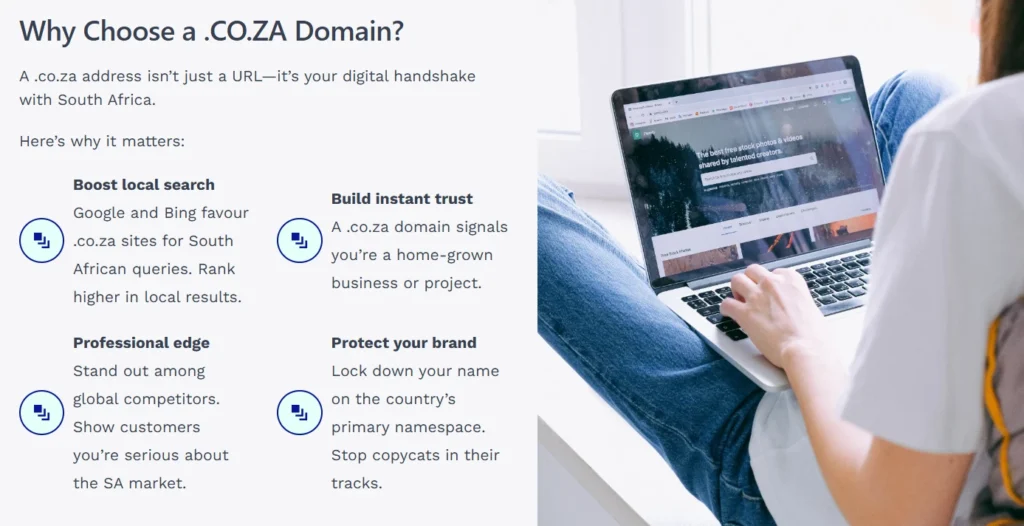
If you want to move the needle on local SEO in South Africa, your extension matters far more than your character count.
Google uses country-code top-level domains (ccTLDs) as a geotargeting signal.
A .co.za extension tells Google your site is relevant to South African queries on Google.co.za.
That geotargeting signal is baked into the algorithm. No amount of domain shortening can replicate what a local extension does for your local search visibility.
By the end of Q3 2024, global ccTLD registrations reached 140.1 million, up 1.4% year on year. Businesses around the world are doubling down on local extensions to build regional credibility.
In South Africa, the .co.za extension carries an added layer of social proof. It tells a South African consumer that you are a local business and that you are accessible.
That message carries real weight in a market where consumers already prefer local platforms by a wide margin.
Nearly half of South African shoppers report buying primarily from local platforms.
The .com versus .co.za debate comes up often among South African founders.
For businesses targeting only the South African market, .co.za is the stronger choice on both trust and local SEO grounds.
For businesses targeting both South African and international audiences, a dual-domain strategy makes practical sense. Register both, and redirect based on your primary audience.
The Practical Domain Length Framework for South African Businesses
Not all domain lengths perform equally in the real world. A useful way to approach character count is through three tiers.
Short domains, 6 to 14 characters, work best for branding, mobile readability, and recall.
Medium domains run from 15 to 20 characters and can work when a descriptive term adds genuine clarity.
Anything above 20 characters starts to feel unwieldy on a mobile screen. To a skeptical South African user, very long domain names read as untrustworthy.
Here is a simple decision process to follow. If your brand name is 14 characters or fewer, register it alone without adding keywords.
If a category term adds real clarity and keeps you under 20 characters, consider it carefully.
If you need hyphens to fit a keyword into the name, stop and choose a different approach entirely. The hyphen is where user trust begins to break down in this market.
The table below summarizes how each length tier performs across the signals that matter most:
| Character Count | Tier | Impact on Trust & Usability | Verdict | SA Example |
|---|---|---|---|---|
| 6 to 14 characters | Short | Brand recall, mobile usability, scam-safe | Ideal | vodacom.co.za |
| 15 to 20 characters | Medium | Works when a keyword adds genuine clarity | Acceptable | africanbank.co.za |
| 21 to 30 characters | Long | Mobile UX suffers, trust signals weaken | Avoid | bestdealsonlinestore.co.za |
| 31 or more characters | Very long | High error rate, spam perception, low CTR | Do not use | topcheapplumbingservicescapetown.co.za |
Indirect SEO Signals That Domain Length Does Affect
Domain length does not directly affect your ranking. However, it influences behaviors that do affect your rankings over time. The clearest example is the click-through rate (CTR).
When your domain appears in a Google search result, it is visible in the URL below your headline. A short, clean, recognizable domain improves the likelihood that a user will click your result.
Higher CTR sends a positive user behavior signal back to Google. That signal feeds into how Google perceives the value of your page over time.
Direct and branded traffic also builds naturally with a memorable domain. When users type your domain directly into a browser, that signals brand authority.
When users search specifically for your brand name, that is another positive signal. Both behaviors grow when your domain is short and easy to remember.
Longer, harder-to-remember domains see lower rates of both behaviors.
So the SEO case for shorter domains is not about character count as a ranking factor.
It is about the downstream user behaviors that a short, memorable name encourages over time.
Five Mistakes South African Businesses Make When Choosing a Domain Name
1) Using exact-match keyword domains
A name like “plumbingservicescapetown.co.za” feels logical because it describes the service. However, Google removed the ranking benefit of exact-match domains back in 2011.
The SEO upside is gone, but the branding downside remains permanently.
2) Choosing description over memorability
A long domain explanation doesn’t train anyone’s memory. A short brand name can become a household name with consistent marketing.
Consider Takealot, Yoco, and Nando’s. None of those names literally describes what the business does.
3) Registering for only one year
A Google patent references multi-year registration as a minor legitimacy signal. Beyond that, single-year registration creates renewal risk.
If you miss a renewal, a competitor or cyber-squatter can grab your name. In South Africa, domain cyber-squatting is a documented and growing threat.
4) Ignoring mobile rendering
Pull up your proposed domain name on a smartphone browser. Look at how it appears in the address bar.
If it gets cut off or looks cluttered, your users experience that same friction every time they visit.
5) Only registering .co.za without securing the .com equivalent
A competitor can register your .com and create genuine brand confusion in the market.
Defensive domain registration is a low-cost move that protects a high-value asset.
Frequently Asked Questions
Does a shorter domain name rank higher on Google?
No, not directly. Ahrefs research found no significant correlation between domain length and Google rankings.
Character length shapes user behavior and trust. Those behaviors can influence rankings indirectly through CTR and branded search volume, but character count is not a direct ranking factor.
Is .co.za better for SEO than .com in South Africa?
Yes, for local search in South Africa. Google uses the .co.za extension as a geotargeting signal. That means your site is more likely to appear in Google.co.za results for South African users. For purely local businesses, .co.za is the stronger choice across both trust and local SEO.
How long should my domain name be?
Aim for 6-14 characters for the strongest combination of brand recall and mobile readability. Up to 20 characters can work if a descriptive term adds genuine clarity. Anything above 20 characters risks both credibility and mobile usability in the South African market.
Does domain length affect click-through rates in search results?
Yes. A short, clean domain in a search result increases user confidence in the link. Higher click-through rates send positive user behavior signals to Google over time. This indirect path is the real SEO value of a well-named domain.
What makes a domain name trustworthy to South African consumers?
Three factors carry the most weight in this market: a .co.za extension, a name under 15 characters, and the absence of hyphens or numbers. Together, these signals that your brand is local, professional, and legitimate. In a market where eight in ten internet users are skeptical of online information, every trust signal counts.
Get The Best ZA Domain Name
A .co.za extension and a name under 15 characters will do more for your brand trust and local SEO than any amount of keyword stuffing into a long domain name ever will.
Pick a name people can say, type, and remember. Register it for multiple years. Then build the brand that makes the name worth searching for.