 Web Hosting
 Windows HostingBuilt for Windows apps and websites – stability, speed and flexibility
 Reseller HostingLaunch a hosting business without technical skills or expensive infrastructure
 Affiliate ProgramRefer customers and earn commissions from sales across our platform
 Domain SearchFind and secure a domain name in seconds with our quick lookup tool
 CO ZA Domains
 All DomainsExplore domain names from over 324 TLDs globally – all in one place
 Free Whois Lookup Tool South Africa
 VPS
VPS Website Builder
 Online ShopSet up a sleek eCommerce store with zero coding knowledge
 SSLs
SSLs SupportAccess help articles, how-tos, and everything about our services
 Blog
Blog Contact UsReach our team instantly via live chat or drop us an email
Finding a VPS in South Africa that actually works for developers is a mission. You need fast deployment, decent RAM, and a data center in Joburg or Cape Town.
Most local VPS options either cost too much or use slow HDD storage. We crawled the web, checked pricing from 5 major providers, and ran a full competitor analysis. The result is a clear guide to the best VPS hosting South Africa has to offer for developers in 2026.
This article focuses on one thing: scalable virtual machines that let you build, test, and deploy without headaches.
Table of Contents
Quick Comparison Table
| Provider | Starting Price (ZAR) | vCPU | RAM | Storage Type | Local Data Center |
| Truehost | R98.80/mo (shared) / ~R600/mo (VPS) | 1 | 2 GB | NVMe SSD | Johannesburg |
| Afrihost | R460/mo (shared) / month(VPS) | 1 | 2 GB | HDD (entry) | Johannesburg & Cape Town |
| Domains.co.za | R139/mo | 1-2 | 2 GB | SSD | Johannesburg |
| Hetzner (Europe) | ~R99/mo (€4.51) | 2 | 4 GB | NVMe SSD | None in SA |
| DigitalOcean | ~R112/mo ($6) | 1 | 1 GB | SSD | Cape Town |
Detailed Reviews of Each Provider
1) Truehost – Best Overall for South African Developers
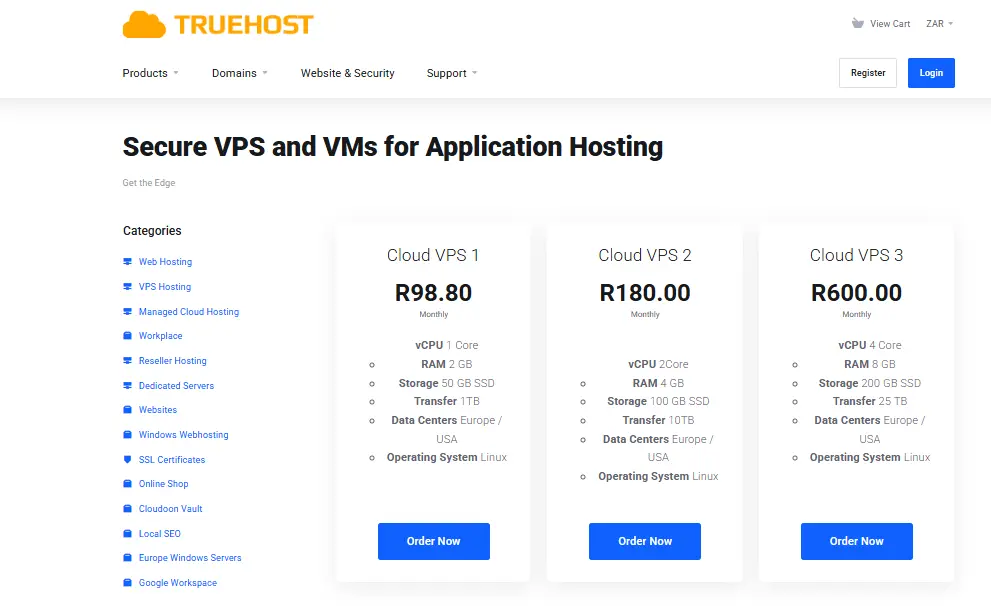
Truehost isn’t trying to copy American hosting companies. It was built specifically for the African market, and that shows in every detail.
Specs (entry-level VPS): 1 vCPU, 2 GB RAM, 50 GB NVMe SSD, 1 TB bandwidth. Their shared hosting starts at just R35 per month with 30 GB NVMe storage.
Scalability: You can scale from 1 core up to 4 cores easily through their control panel. Truehost also offers triennial billing cycles, which locks in low prices if you pay for three years upfront.
Data center location: Johannesburg. This is a big deal. Your API responses and website loads stay under 20ms for local South African users.
Pricing: The Cloud VPS plan starts around R120 per month when billed triennially. Shared hosting goes for R35 per month with 30 GB NVMe, which is almost unheard of in this market.
Pros:
- Prices locked in Rands—no surprise exchange rate fees
- 24/7 WhatsApp support (this alone saves hours of waiting)
- NVMe storage is much faster than standard SSDs
- Uses LiteSpeed web servers, which are up to 20x faster than Apache
- Free SSL certificate with every account
Cons:
- Best discounts require paying for three years upfront
- Some advanced cloud features (like load balancers) aren’t available on lower-tier plans
2) Afrihost
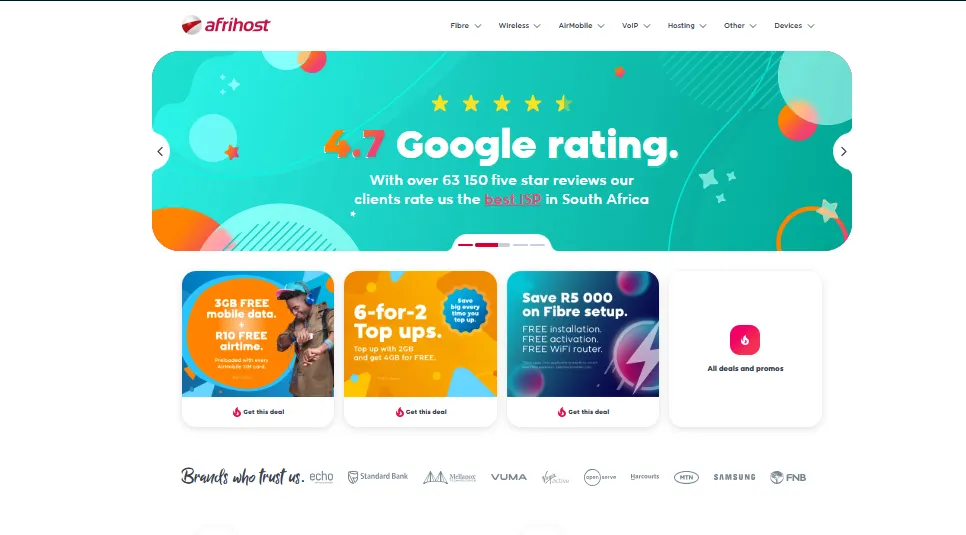
Afrihost is a household name in South Africa. Many developers start here because they know the brand from mobile data and ADSL.
Specs: Their entry-level VPS (Bronze) comes with 1 vCPU, 2 GB RAM, but here’s the catch—100 GB HDD storage. That’s an old spinning disk, not SSD. For a developer running databases or modern frameworks, HDD will slow you down.
Scalability: Afrihost offers both managed and self-managed options. Their cloud hosting starts from R397 per month for managed plans.
Data center: Johannesburg and Cape Town. Local latency is good at around 50ms.
Pricing: Shared hosting from R89 per month. True VPS pricing starts much higher—around R310 per month for the Bronze VPS.
Pros:
- Trusted local brand with a good reputation
- Decent mobile app for server management
- WhatsApp and app-based support
Cons:
- Entry-level VPS uses HDD storage in 2026—this is a dealbreaker for many devs
- Much more expensive than Truehost for similar specs
- Support can be slow on weekends
3) Domains.co.za – Solid AMD Epyc VPS
Domains.co.za is best known as a domain registrar, but their VPS offerings have gotten much better recently. They use AMD Epyc processors, which are powerful chips.
Specs (Linux Epyc VPS 1): 1-2 vCPUs, 2 GB RAM, 50 GB SSD storage, unlimited bandwidth.
Scalability: They go all the way up to 12 vCPUs and 48 GB RAM on their managed cPanel VMs. Those high-end plans start at R2,899 per month and include premium software worth R2,000 per month at no extra cost.
Data center: Johannesburg (N+1 Datacenter). Their infrastructure is solid and well-maintained.
Pricing: R209 per month for the entry-level Epyc VPS. That’s higher than Truehost but lower than Afrihost’s VPS.
Pros:
- AMD Epyc chips deliver strong performance
- 60-day money-back guarantee
- Good for high-traffic WordPress or e-commerce sites
Cons:
- Support is slower on weekends
- Their control panel can feel overwhelming for beginners
- No NVMe storage on entry-level plans
4) Hetzner – Cheap but Far Away
Hetzner is a German company famous for giving you a lot of server power for very little money. Many developers love them for the price-to-performance ratio.
Specs (CPX22): 2 vCPU, 4 GB RAM, 80 GB NVMe SSD, 20 TB bandwidth.
Scalability: Cloud servers are billed by the hour. You can spin up a server, use it for two hours, and destroy it. That flexibility is great for testing.
Data center: Germany, Finland, USA. No data center in South Africa. This is the killer problem.
Pricing: Currently €5.99 per month (~R112), but Hetzner has announced a price increase starting April 1, 2026. The CPX22 will go up to €7.99 per month (~R150).
Pros:
- Excellent price-to-performance ratio
- 20 TB bandwidth is massive
- Hourly billing gives you flexibility
Cons:
- No local data center. Your latency will be 150ms or higher for South African users
- You pay in Euros, so the Rand exchange rate hits you every month
- No phone support; tickets only
- Prices are going up in April 2026
5) DigitalOcean – The Developer Favorite
DigitalOcean is the go-to for startups and solo developers worldwide. They finally opened a Cape Town data center a few years ago, which made them a real option for South Africans.
Specs (Basic Droplet): 1 vCPU, 512 MB RAM, 10 GB SSD, 500 GB transfer. The 1 GB RAM option costs $6 per month (~R112).
Scalability: This is where DigitalOcean shines. You can resize droplets with a few clicks. Hourly billing means you only pay for what you use.
Data center: Cape Town, South Africa. This is a genuine local option with good latency.
Pricing: Starts at $4 per month (~R75) for 512 MB RAM, but that’s not enough for most real applications. A usable 2 GB RAM droplet costs $12 per month (~R225).
Pros:
- Amazing documentation and tutorials
- Best API in the business
- Great for microservices and containerized apps
- Hourly billing is perfect for short-term projects
Cons:
- Entry plan has only 512 MB RAM—barely enough for a modern Node.js app
- Gets expensive quickly. A 4 GB RAM droplet costs $24 per month (~R450)
- No cPanel included. You manage everything from the command line
- Support is ticket-based only
Competitor Analysis: What Other Providers Miss
We searched the market and found three big gaps that most VPS providers leave open.
Gap 1: Local NVMe vs. International Prices
International hosts like Hetzner and DigitalOcean offer great prices, but the Rand exchange rate hurts you. Local hosts like Afrihost offer low latency, but their entry-level VPS still uses old HDD storage.
How Truehost fills the gap: Truehost offers NVMe storage (5x faster than regular SSD) at a local Johannesburg price that matches Hetzner’s value. Their shared hosting starts at R35 with 30 GB NVMe, and VPS plans follow the same pattern.
Gap 2: Support Channels That Actually Work
Most providers use ticketing systems that take hours or days. DigitalOcean has no phone or WhatsApp support. Afrihost has app support but can be slow on weekends.
How Truehost fills the gap: Truehost provides 24/7 WhatsApp support. In South Africa, WhatsApp is how people actually communicate. You get a human who can help with SSH issues or deployment problems without waiting for an email ticket.
Gap 3: Billing in Rands
AWS, Vultr, DigitalOcean, and Hetzner all force you to pay in US Dollars or Euros. If you’re a freelancer or running a small business, your hosting bill goes up whenever the Rand drops.
How Truehost fills the gap: Truehost bills exclusively in South African Rands. You know exactly what you pay every month. No bank fees for currency conversion. No surprises when the exchange rate moves.
How to Choose a VPS for Development
Use this checklist before you sign up for any VPS provider.
1. Check the storage type
If the plan says “HDD,” walk away. You need NVMe or at least SSD. HDD makes npm install and database queries painfully slow. Afrihost’s entry VPS still uses HDD—skip it.
2. Look at RAM carefully
For a typical Laravel, Django, or Node.js app, 2 GB is the minimum. 512 MB (DigitalOcean’s entry) is only for tiny static sites or lightweight proxies.
3. Verify the data center location
Run a ping test or use a lookup tool. If the server is in Europe or the US, your local South African API calls will have 150ms+ lag. Johannesburg or Cape Town is a must for local users.
4. Ask about support before you need it
Do they respond on WhatsApp or chat at 2 AM? If you’re a solo developer working late nights, this matters a lot.
5. Calculate the real cost in Rands
If the price is in $ or €, add 15-20% for the exchange rate and bank fees. Always prefer providers that bill in ZAR.
Best Use Cases for Developers
Staging and testing environments (Winner: Truehost or Hetzner)
If you just need a server to test code that nobody else sees, Truehost’s R35 shared hosting or R120 VPS is perfect. Hetzner’s hourly billing is also good for short-term testing, but you must manage the Euro conversion and accept 150ms latency.
APIs and microservices (Winner: DigitalOcean or Truehost)
DigitalOcean wins for API deployment because of their excellent load balancers and App Platform. However, for a simple API running on Node.js or Python that serves local clients, Truehost in Johannesburg gives you lower latency at a better price.
High-traffic WordPress or e-commerce (Winner: Domains.co.za)
If you’re hosting a busy online store, Domains.co.za’s Managed cPanel VM (starting at R2,899 per month) is fully managed. Their team handles security patches and server optimization so you can focus on coding the frontend.
Database server (Winner: Truehost)
You need fast disk I/O for MySQL or PostgreSQL. Truehost’s NVMe storage in Johannesburg provides the fastest read/write speeds without paying international data fees. Their NVMe drives are much faster than standard SATA SSDs.
Short-term projects or batch jobs (Winner: DigitalOcean or Hetzner)
Need a server for two days to run a data processing script? DigitalOcean and Hetzner both offer hourly billing. Spin it up, run your job, destroy it, and pay only for the hours you used.
Final Recommendation by Use Case
So what is the best VPS hosting South Africa for developers?
- Get Truehost if: You want the best balance of price (R35 shared / ~R120 VPS), speed (NVMe storage), and local support (WhatsApp). It fills every gap left by the bigger international brands. Perfect for freelancers and small dev teams.
- Get DigitalOcean if: You need advanced cloud tools like Kubernetes, load balancers, or you love their documentation and API. Be ready to pay more for usable RAM and deal with USD pricing.
- Get Afrihost if: You only care about brand trust and don’t mind paying double for HDD storage on entry-level VPS. Good for non-technical users who want a familiar name.
- Get Domains.co.za if: You need a large, fully managed server for a high-revenue business and you have the budget for their managed cPanel plans starting at R2,899 per month.
- Get Hetzner if: You’re building something that serves a European or global audience, and latency to South Africa doesn’t matter. Just be aware of the April 2026 price increases.
For 90% of South African developers reading this article, Truehost is the smart choice. You get local NVMe storage, Johannesburg data centers, WhatsApp support, and prices locked in Rands. That combination is hard to beat in 2026.
Frequently Asked Questions
Q1: Can I run Docker containers on a Truehost VPS?
Yes. Truehost’s VPS plans run on KVM virtualization, which fully supports Docker. You can install Docker Engine on any of their Linux VPS plans and run containers just like you would on DigitalOcean or any other cloud provider.
Q2: What’s the difference between managed and unmanaged VPS?
Managed VPS means the hosting provider handles security updates, server monitoring, and basic maintenance. Unmanaged VPS means you do everything yourself—from securing SSH to installing software. Truehost offers both options. Unmanaged is cheaper, managed saves you time.
Q3: How do I migrate my existing website to a new South African VPS?
Most providers offer free migration support. Truehost includes free website migrations with their plans. For DigitalOcean and Hetzner, you’ll need to handle the migration yourself using tools like rsync or a manual backup and restore.
Q4: Which VPS provider has the best uptime in South Africa?
All five providers in this comparison offer 99.9% uptime guarantees or better. Domains.co.za specifically promises 99.9% uptime in their SLA. Truehost’s local Johannesburg data center gives them an edge for South African visitors because network routes are shorter and more stable.
Q5: Do I need a VPS for a small WordPress site or can I use shared hosting?
For a small WordPress site with low traffic (under 10,000 visits per month), shared hosting is fine. Truehost’s shared hosting at R35 per month with 30 GB NVMe storage is more than enough. Upgrade to VPS when your traffic grows, you need custom software installed, or you want dedicated CPU cores and RAM that aren’t shared with other users.